





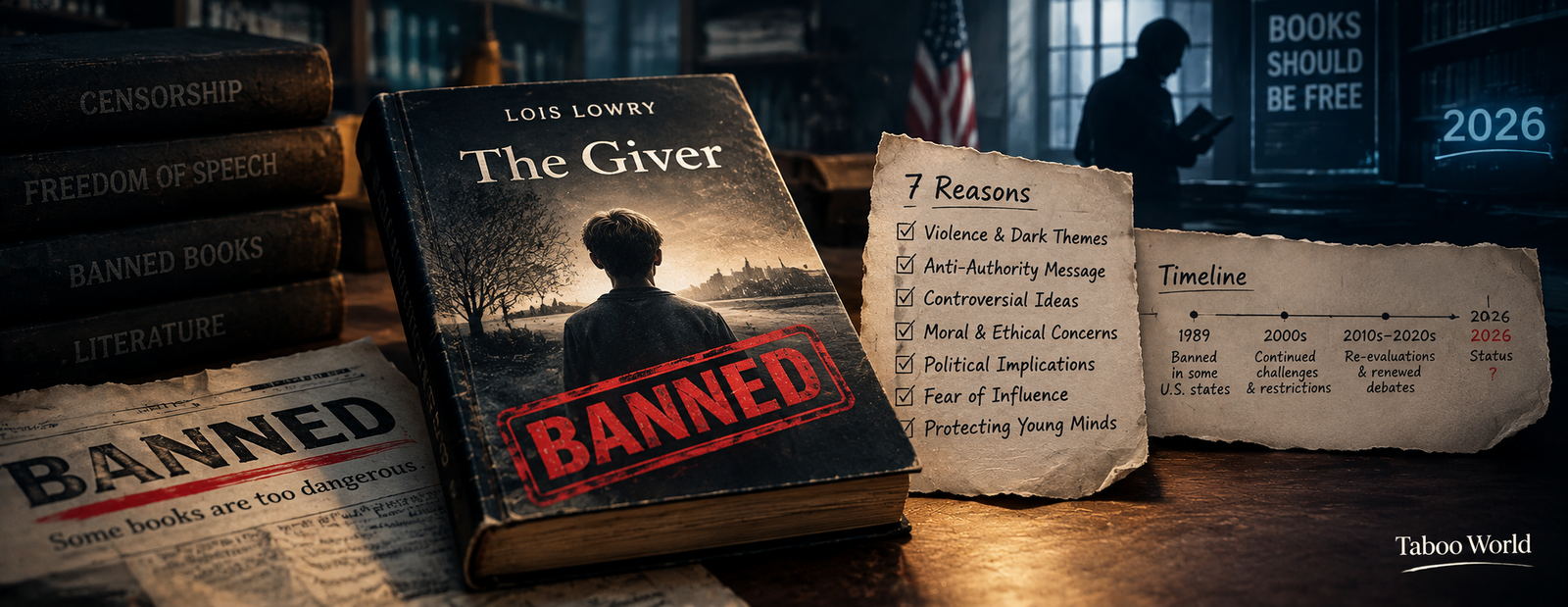
Quick answer: The Giver by Lois Lowry was banned and challenged in U.S. schools mainly because parents said it was too dark for middle schoolers. The top complaints were infanticide (a baby is killed), euthanasia of the elderly, a suicide, a “Stirrings” pill linked to puberty, violent war memories, its picture of motherhood, and claims […]
Quick answer: The Giver by Lois Lowry was banned and challenged in U.S. schools mainly because parents said it was too dark for middle schoolers. The top complaints were infanticide (a baby is killed), euthanasia of the elderly, a suicide, a “Stirrings” pill linked to puberty, violent war memories, its picture of motherhood, and claims of “occult” ideas. Most challenges failed, and the book is still widely taught in 2026.
Watch: why The Giver was banned, in 45 seconds
Spoiler warning: This article explains key scenes from The Giver, including the ending of the “release” mystery.
What Is The Giver About? (30-Second Summary)
Jonas lives in “the Community,” a calm, colorless world built on Sameness. There is no pain, no war, no hunger, and no real choice. At 12, he is chosen as the next Receiver of Memory and trained by an old man called the Giver, who holds all the memories of the past. Jonas starts to see color (first the red of his friend Fiona’s hair), feel real emotions, and learn the truth about “release.” To save a baby named Gabriel from being released, he escapes the Community. These hidden truths are exactly what made the book a target.
The Giver Ban at a Glance
| Book | The Giver by Lois Lowry (1993) |
| Award | Newbery Medal, 1994 |
| First challenge | 1994, the same year it won the Newbery |
| ALA ranking (1990–1999) | #11 on the ALA list of most challenged books of the 1990s |
| ALA ranking (2000–2009) | #23 on the ALA 2000–2009 list |
| Main reasons | Infanticide, euthanasia, suicide, sexual awakening, violence, motherhood, “occult” themes |
| Where | School districts in California, Kansas, Missouri, Montana, New York, Oklahoma, Colorado and other U.S. states |
| Usual outcome | Retained or restricted (parent permission, older grades only), rarely removed for good |
| Status in 2026 | No national ban; still a standard middle school novel |
Why Was The Giver Banned? The 7 Real Reasons
Unlike many banned books, The Giver was not targeted for swearing or graphic sex. As the Comic Book Legal Defense Fund noted in 2014, most formal complaints fall under one label: “unsuited to age group.” In plain words, parents felt the ideas were too heavy for 11 to 14-year-olds. Here is what they objected to, and the exact part of the book behind each complaint.
1. Infanticide: the “release” of a newborn twin
This is the number one reason. In the community, when identical twins are born, the smaller baby is “released.” Jonas watches a recording and learns that release means death. His own father, a gentle Nurturer, gives the baby a lethal injection and drops the body down a chute. Parents in several districts called this scene disturbing and said it could “desensitize” children to killing.
2. Euthanasia of the elderly
Old people in the community live in the House of the Old until they are “released” in a ceremony that looks like a celebration. Readers later understand it is the same lethal injection. A complaint in Johnson County, Missouri argued the book made euthanasia seem normal to kids.
3. Suicide
Rosemary, the Receiver chosen before Jonas, could not bear the painful memories and asked to be released. In other words, she chose to die. Some parents said this subplot presented suicide as a way out of pain.
4. “Sexual awakening” and the Stirrings pills
Jonas dreams about wanting Fiona to bathe with him. In the community, these feelings are called “the Stirrings,” and children take a daily pill to stop them. The scene has no sex at all, but challengers in 2001 and 2005 still described the book as “sexually explicit” or “lewd.” Others objected to what they called “pill-popping.”
5. Violence and war memories
The Giver passes painful memories to Jonas, including a battlefield where a young soldier dies asking for water. Parents in a California district complained about violent passages as early as 1994.
6. “Occult” and anti-authority themes
Jonas receives memories through a kind of mental transfer. In Oklahoma, a parent objected to words like “clairvoyance,” “transcendent” and “guided imagery,” calling them New Age practices. Other critics disliked that a child defies the rules, breaks his community’s laws and runs away. In Sidney, New York, a parent objected to the book’s mind control, selective breeding and killing of the weak.
7. The way motherhood and birth are shown
In the Community, some girls are assigned the job of “Birthmother.” They have three babies through artificial means, never raise them, and are then moved to hard labor. Babies are handed to approved couples. A 1995 complaint in Kansas called this a “degradation of motherhood.” Some readers also claimed the newborn release scene was a hidden message about abortion, even though the book presents it as a killing that the hero rejects.
Book Scene vs. Complaint: Side-by-Side
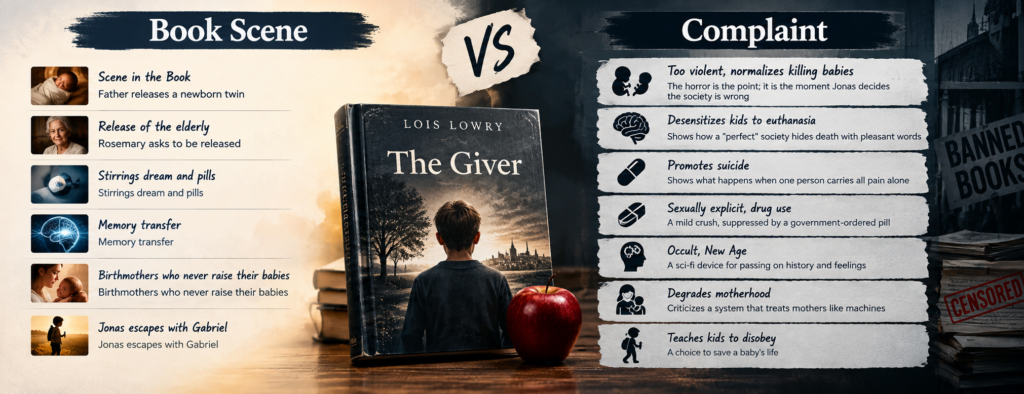
| Scene in the book | What challengers said | What the story actually shows |
|---|---|---|
| Father releases a newborn twin | Too violent, normalizes killing babies | The horror is the point; it is the moment Jonas decides the society is wrong |
| Release of the elderly | Desensitizes kids to euthanasia | Shows how a “perfect” society hides death with pleasant words |
| Rosemary asks to be released | Promotes suicide | Shows what happens when one person carries all pain alone |
| Stirrings dream and pills | Sexually explicit, drug use | A mild crush, suppressed by a government-ordered pill |
| Memory transfer | Occult, New Age | A sci-fi device for passing on history and feelings |
| Birthmothers who never raise their babies | Degrades motherhood | Criticizes a system that treats mothers like machines |
| Jonas escapes with Gabriel | Teaches kids to disobey | A choice to save a baby’s life |
Timeline: Every Major Challenge to The Giver
| Year | Place | Complaint | Outcome |
|---|---|---|---|
| 1994 | Bonita Unified School District, California | Violent and sexual passages | Temporarily banned, later returned |
| 1995 | Franklin County, Kansas | Murder, suicide, “degradation of motherhood and adolescence” | Removed from school libraries; teachers could still use it |
| 1995–96 | Columbia Falls, Montana | Infanticide and euthanasia | Kept, but younger students needed parent permission (Montana record) |
| 1990s | Johnson County, Missouri | Desensitizes children to euthanasia | Challenged |
| 1990s | Sidney, New York | Mind control, selective breeding, killing the weak | Challenged |
| 1990s | Oklahoma school district | “Occult” words like clairvoyance and guided imagery | Kept, but banned from elementary assignments |
| 2001 | Colorado (reported to ALA) | Violence, occult themes, sexually explicit | Banned locally |
| 2005 | Blue Springs, Missouri | Parents called it “lewd” and “twisted” | Reviewed by two district committees |
| 2006–2007 | Seaman USD 345, Kansas | Challenged in elementary school library | Retained both years |
| 2007 | Mt. Diablo School District, Concord, California | Pill-popping, suicide, lethal injections of babies and elderly | Parents asked for removal from reading lists and libraries |
| 2014 | Nationwide | Movie release sparked fears of new challenges | Free speech groups prepared for a new wave |
Challenges have also been reported in Ohio and Florida, but without reliable dates or outcomes.
Fact check: Was The Giver really challenged 11,000 times? This number appears on several blogs, but no primary source backs it up. The American Library Association does not publish a per-book total, and it says most challenges are never reported at all. What is verified: The Giver was the #11 most challenged book of the 1990s and #23 of the 2000s. Some sites also list a “1991” challenge, which is impossible because the book came out in 1993.
The Pattern Most Articles Miss
Look at the outcomes column above and a clear pattern appears. The Giver was challenged far more often than it was actually banned. Most school boards reviewed the book and kept it. The usual compromise was a restriction, not a removal: parent permission slips, or moving the book from elementary to middle school.
That matters because “banned” and “challenged” are not the same thing:
- Challenged: someone files a formal complaint asking to remove a book.
- Restricted: the book stays, but with limits (age, grade or permission).
- Banned: the book is actually removed from a library or curriculum.
For The Giver, most cases sit in the first two groups. This is why the book could be one of the most challenged titles of the 1990s and still be one of the most assigned novels in American middle schools at the same time.
Why Did a Children’s Book Scare Adults So Much?
The real issue was not one scene. It was the message. The Giver shows a community that looks safe and polite on the surface, but hides killing behind soft words like “release.” It teaches kids to ask hard questions about rules, comfort and authority. Lowry herself suggested the deeper fear was about adults having to re-examine their own beliefs.
The story was also inspired by something very human. Lowry has said the idea came from visiting her elderly father, who was losing his memory. That led her to wonder what life would be like if painful memories could simply be removed.
What Lois Lowry Said About the Bans
Lowry has spoken against censorship for decades. On her website she told a young reader, “I think banning books is a very, very dangerous thing.” Her view is simple: a parent can decide their own child should not read a book, but no one should make that choice for every other family. She has also said that challengers often pulled scenes out of context.
Is The Giver Still Banned in 2026?
No. The Giver is not banned nationally in the United States. It remains a common grade 6–8 novel (about a 760L reading level) and still appears on recommended lists such as Texas’s 7th grade texts. Local challenges still happen from time to time, but it has not been a lead target of the recent book ban wave tracked by PEN America, which has focused mostly on books with sexual content or LGBTQ+ themes. For the current status, districts and restrictions, check our The Giver banned book record.
Should Kids Read The Giver? A Quick Guide for Parents
- Best age: 11 to 14, which is the age it was written for.
- Hardest scene: the release of the newborn twin (Chapter 19). Read it together if your child is sensitive.
- Good talking points: Is a world without pain worth losing color, love and choice? Why do leaders use soft words for hard things?
- No graphic content: there is no swearing and no sex scene. The “Stirrings” part is a short dream.
Key Takeaways
- The Giver was banned because parents said its themes (infanticide, euthanasia, suicide, puberty, violence, motherhood) were too dark for young readers.
- It was the #11 most challenged book of the 1990s and #23 of the 2000s on ALA lists.
- Most challenges ended with the book kept or restricted, not removed.
- In 2026, it is not banned nationally and is still widely taught.
FAQs
Why was The Giver banned in schools?
Schools faced complaints that the book was not suitable for its age group. Parents objected to the killing of a newborn, euthanasia of the elderly, a suicide, the “Stirrings” pills and violent war memories.
When was The Giver first banned?
In 1994, the same year it won the Newbery Medal, a California school district temporarily banned it after parents complained about violent and sexual passages.
Why is The Giver considered controversial?
It shows a “perfect” society that secretly kills babies and old people and controls feelings with pills. Some adults saw this as too dark; supporters see it as a warning about giving up freedom for comfort.
Is The Giver inappropriate for 12-year-olds?
Most teachers and librarians say no. It was written for readers around 11 to 14, has no explicit content, and is a standard middle school novel. Some scenes are emotional, so a parent talk can help.
Does The Giver promote abortion?
No. Some challengers made this claim about the newborn release scene, but the book shows the killing as a horror. It is the moment Jonas decides to escape and save Gabriel’s life.
Was The Giver movie banned too?
No. The 2014 film was not banned. Its release only raised concerns that the book might face a new wave of school challenges.
Is The Giver banned or just challenged?
Mostly challenged. Dozens of formal complaints have been filed since 1994, but most school boards kept the book or added limits such as parent permission or older grades only. Full removals were rare and usually temporary.