
Listen to this article 1× Quick answer: The US Iran war today, November 4, 2026: US forces struck radar and missile launchers on Iran’s Qeshm Island on November 2, calling it defensive. Trump says there is “no rush” on major strikes. Qatar-led talks continue, and Qatari mediators expected both sides to answer a new proposal […]
Quick answer: The US Iran war today, November 4, 2026: US forces struck radar and missile launchers on Iran’s Qeshm Island on November 2, calling it defensive. Trump says there is “no rush” on major strikes. Qatar-led talks continue, and Qatari mediators expected both sides to answer a new proposal within 36 hours.
Why we checked this: we rebuilt this update from CNN, ABC News, CBS News, Al Jazeera, AP and Reuters reports, plus US Energy Information Administration data. We also checked every claim in our October 27 version against what has happened since.
Key facts at a glance
- US forces hit Qeshm Island on November 2, one day before the US midterms, after Trump had pledged no strikes before the vote.
- Two US officials told CNN on October 26 that major Iran strikes could start within 96 hours of a Trump order.
- Israel’s October 27 election produced no majority: Netanyahu’s bloc won 53 of the 61 seats needed.
- Oil flows through the Strait of Hormuz fell to 14.6 million barrels per day in early 2026, down about 30%.
- Brent crude traded at $105.12 on November 3 after news of the Qeshm strike.
- The June 17 Islamabad Memorandum is still the only signed US-Iran framework.
What happened in the US Iran war today?
The biggest change since our last update is that US strikes are no longer hypothetical. On Monday, November 2, US forces struck radar detectors and missile launchers on Qeshm Island, The Hill reported. Qeshm is the largest island in the Strait of Hormuz.
US officials called it “a defensive measure for Iranians using surface to air missiles against US assets.” One official told the Jerusalem Post that IRGC personnel had fired a missile from Qeshm toward an American aircraft.
The Wall Street Journal, which first reported the strike, said Washington has quietly carried out limited strikes on Iran for several weeks. Officials kept them unannounced so they would not signal a return to full combat.
Iran’s Revolutionary Guards said they downed two US drones south of Qeshm that day, Tasnim reported. Israel’s military said it had no role in the strike. Deputy Foreign Minister Kazem Gharibabadi said Tehran reserves the right to self-defence.
Did Trump break his promise not to strike before the midterms?
It depends on how you define a strike. Trump had promised no strikes on Iran before the November 3 vote. NBC News noted the Qeshm raid happened anyway, while officials stressed it was defensive and not a new offensive.
Trump himself confirmed US strikes in a Fox News phone interview on Tuesday, Gulf News reported. In a separate Fox interview, he said the US “might have to go after” Pickaxe Mountain, a site linked to Iran’s nuclear program.
His public tone stayed mixed. Trump said he was in “no rush” to decide on major strikes. He also posted that a deal “could happen” and that Iran wants a settlement as soon as possible.
How ready is the US for a major strike on Iran?
Very ready, according to CNN’s October 26 report. Two US officials said forces could launch major operations within 96 hours of a Trump order. The plans go beyond what officials call “mowing the lawn,” meaning the limited hits of recent months.
The reported target list includes Iranian energy infrastructure, military sites and nuclear facilities. Officials told CNN the job would be harder now, because Iranian forces have learned American tactics.
A senior Pentagon official kept the statement neutral: “The Department is a planning organization, and its job is to develop and execute military options ordered by the President.”
US intelligence expects fast retaliation. Recent assessments say Iran and the Houthis would hit American personnel and facilities in the region, and possibly beyond it.
What did the US intelligence memo warn about?
On October 23, Director of National Intelligence Jay Clayton sent a one-page unclassified memo to Secretary of State Marco Rubio. It said Iran had “substantially increased efforts to target US personnel,” Reuters and Arab News reported.
Clayton wrote that lethal plots had reached advanced stages in the Middle East and certain other countries. CIA Director John Ratcliffe was copied on the memo, which Axios first published.
The memo named no specific targets or countries outside the Middle East. Clayton offered to downgrade the underlying intelligence so more State Department staff could see it.
Where do US Iran peace talks stand now?
Talks are active but unresolved. Qatar is leading mediation with backing from Egypt, Saudi Arabia, Pakistan and Turkey, The Hill reported. Iranian officials held three straight days of talks in Doha, then Qatari mediators flew to Tehran.
Foreign Minister Abbas Araghchi told Al Jazeera that Qatar proposed shortening the implementation period of Iran’s plan to five days. Earlier, he described talks on a two-day plan to reopen the Strait of Hormuz.
Vice President JD Vance wrote to Mohsen Rezaei, Iran’s top security official, and offered to lead a US delegation in direct talks. Vance says Washington has set no deadline for a deal.
Iran is less upbeat. Tehran says the US response to its demands was “not convincing” and insists the US lift its naval blockade first. Qatar still says it hopes for an interim deal.
What is the Islamabad Memorandum?
It is the only signed US-Iran framework so far. Trump and President Masoud Pezeshkian signed it electronically on June 17, 2026, with Pakistan’s Prime Minister Shehbaz Sharif signing as guarantor.
The 14-point document set an extendable 60-day window to negotiate a final agreement. It followed a Pakistan-brokered ceasefire in April, and both sides agreed in August to extend it.
How did Israel’s election change the war?
It weakened Netanyahu without removing him. Final Central Elections Committee figures gave his bloc 53 seats and the opposition bloc 48. Neither side reached the 61 seats needed to govern.
Arab parties won a combined 19 seats, the Jerusalem Post reported. Opposition leader Gadi Eisenkot has refused to serve under Netanyahu, so weeks or months of deadlock may follow, CNN said.
Netanyahu’s push for war has not stopped. AP sources say he is pressing Trump to attack Iran after the midterms. Before the vote, Israeli sources said Trump refused his request for a joint strike before the US election.
Why is the Strait of Hormuz still a war zone?
The strait carried 20.9 million barrels per day in 2023, about 20% of world petroleum consumption, EIA data shows. No other oil route comes close to that size.
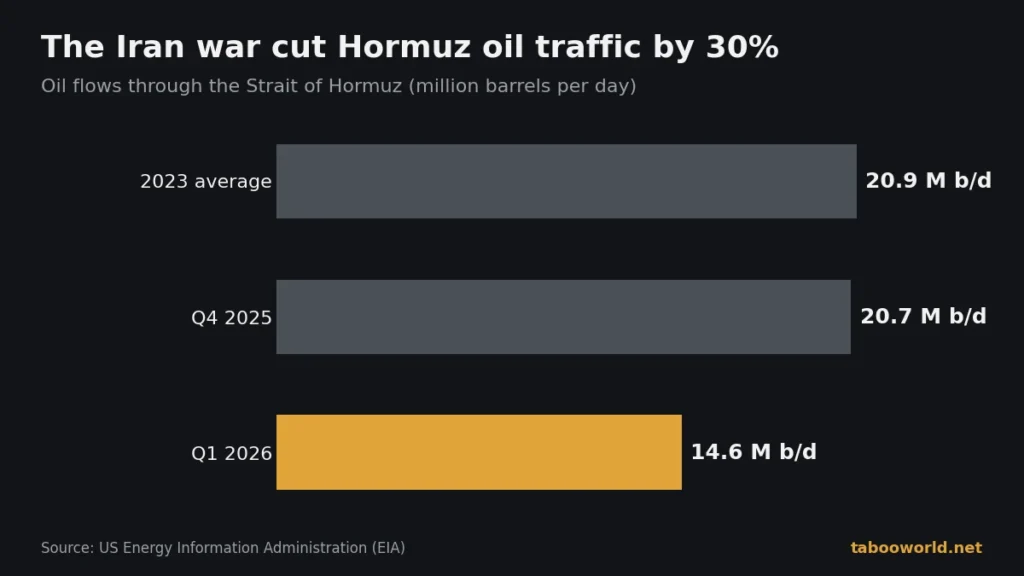
The war cut that flow sharply. Hormuz volumes fell to 14.6 million barrels per day in the first quarter of 2026, down from 20.7 million in late 2025, the EIA reported in May.
Trump disputes the damage. On October 21 he said more oil is flowing than before the war and accused Iran of lying about mines to lift prices.
“Iran is a failing nation. We’re taking all the oil out that we want,” Trump told reporters, according to ABC News.
The US keeps a naval blockade on Iran’s Persian Gulf and Gulf of Oman ports. Iran claims control of the strait and keeps claiming attacks on ships. ABC News reports that Iranian attacks on commercial shipping increased in recent weeks.
CENTCOM commander Adm. Brad Cooper flew over the strait on October 25, where US crews have been clearing Iranian mines. Al Jazeera called October the worst month yet for ships there.
What does this mean for oil prices?
Every strike report adds a risk premium. Brent crude rose to $105.12 a barrel and US crude to $97.32 on November 3, after news of the Qeshm raid, CNBC reported.
Hopes for a deal pull prices the other way. Brent dropped 3.2% over the weekend before the strike as talks in Doha progressed, EA WorldView noted. Expect sharp moves in both directions until a deal or a major strike happens.
How are the Houthis pulling the region deeper in?
Iran’s Yemeni allies have turned Saudi Arabia into a second front. Houthi strikes on three Saudi airports between October 6 and 21 killed 22 people and injured more than 380.
The deadliest hit King Khalid International Airport in Riyadh on October 10, killing 13, including one American, and injuring 308. Saudi civil defense issued fresh warnings for Riyadh, Khamis Mushait and Abha on October 25.
Attacks continue into November. The Saudi-led coalition said it intercepted a Houthi ballistic missile and two drones near Riyadh on November 2. US War Secretary Pete Hegseth and Saudi defense chief Prince Khalid bin Salman discussed the Houthi strikes this week.
Washington is bracing. The US Embassy in Riyadh is under ordered departure, CNN reports, and other missions may follow. Nonessential troops due for the next Middle East rotation will no longer be sent.
What is happening inside Iran?
Pressure is turning inward. Al Jazeera reports that hardliners have turned against President Pezeshkian over the US negotiations. The IRGC is taking its “Janfada” mobilisation campaign to main squares in all 31 provinces.
Iran’s Basij commander threatened US troops worldwide with unrestricted attacks this week, Iran International reported. Tehran officials say they favour diplomacy but are ready to answer any US attack.
Full timeline of the 2026 US Iran war
| Date (2026) | Development | Reported by |
|---|---|---|
| Feb 28 | War begins with joint US-Israeli strikes on Iran | ABC News |
| April | Pakistan-brokered ceasefire agreed | Reuters |
| Jun 17 | Islamabad Memorandum signed by Trump and Pezeshkian | Al Jazeera |
| Oct 10 | Houthi missile kills 13 at Riyadh airport | AP, BBC |
| Oct 23 | DNI memo warns of advanced Iranian plots against US officials | Axios, Reuters |
| Oct 25 | Saudi civil defense warnings for Riyadh, Khamis Mushait and Abha | ABC News |
| Oct 26 | US forces ready for major strikes within 96 hours | CNN |
| Oct 27 | Israeli election ends with no majority | ABC News, CNN |
| Oct 30 to Nov 1 | Iranian delegation holds three days of talks in Doha | Al Jazeera |
| Nov 2 | US strikes Qeshm Island; IRGC claims two US drones downed | WSJ, ABC News, Anadolu |
| Nov 3 | US midterms held; Qatar awaits answers to new proposal | Reuters, Iran International |
What is confirmed and what is still unclear?
| Claim | Status |
|---|---|
| US struck Qeshm Island on Nov 2 | Confirmed by US officials and Trump |
| IRGC downed two US drones | Iranian claim; not confirmed by the US |
| US will launch major strikes after the midterms | Plans ready; no decision announced |
| US accepted Iran’s conditions | Iranian claim; Washington has not confirmed |
| Oil flows now exceed pre-war levels | Trump claim; latest EIA data shows a 30% drop |
Key takeaways
- Limited US strikes on Iran are already happening, and the Qeshm raid made them public.
- A major US campaign is planned and ready, but Trump has not ordered it.
- Qatar’s mediation is the main brake, with both sides due to answer its latest proposal.
- Netanyahu is weaker at home after the election but still lobbying for war.
- Hormuz traffic and Houthi attacks on Saudi Arabia keep oil above $100.
The Saudi front has its own fast-moving story. Our Houthi attack tracker for Saudi Arabia logs every airport strike, death toll and disputed Mecca or Medina claim.
[FLAG: Writer input needed | Intent: keep your earlier internal links (war background explainer, Putin mediator piece, Yemen strike and sea-exodus stories) | Problem: the draft had anchor text but no URLs | What would help: paste the live URLs so each goes in its own paragraph]
Frequently asked questions
Did the US attack Iran this week?
Yes. US forces struck radar and missile launchers on Iran’s Qeshm Island on November 2, 2026. Officials called the raid defensive, a response to Iranian missiles fired at US aircraft. They said it was not the start of a major new offensive.
Will the US launch major strikes on Iran after the midterms?
No decision has been announced. Two US officials told CNN that forces can start major operations within 96 hours of an order. Trump says there is no rush and that a deal could happen.
Are US Iran peace talks still alive?
Yes. Qatar is leading indirect talks backed by Egypt, Saudi Arabia, Pakistan and Turkey. Iran calls the latest US response unconvincing, while Qatar still hopes for an interim deal.
Is the Strait of Hormuz open to shipping?
Partly. Oil still moves, but flows fell to 14.6 million barrels per day in early 2026, about 30% below late 2025, EIA data shows. Iran claims attacks on ships, and the US blockades Iranian ports.
Who won the Israeli election?
Nobody won a majority. Netanyahu’s bloc took 53 seats and the opposition bloc 48, short of the 61 needed. Arab parties won 19 seats, and coalition talks could take weeks.
Sources
- US EIA: Strait of Hormuz and Red Sea oil flows
- Anadolu: Hormuz oil flows fall nearly 30% in Q1, EIA says
- ABC News: US carries out defensive airstrikes on Qeshm Island
- The Hill: US military strikes Qeshm Island day before midterms
- France 24: US strikes Qeshm Island as Trump signals progress
- CNBC: Oil rises after report of US strike on Qeshm
- CNBC: Vance hopes for negotiated settlement with Tehran
- Arab News/Reuters: Intelligence memo on Iranian plots
- Axios: US intel memo warns of advanced Iranian plots
- Al Jazeera: Mediators continue US-Iran negotiations
- CBS News: Iran plays down hope for deal after new US strikes
- ABC News: Israel final election results
- CNN: Netanyahu hasn’t won, but hasn’t lost either
- Al Jazeera: Iran and US sign memorandum to extend ceasefire