
France Blames Iran Revolutionary Guards for Fridge Cyber Attacks
Listen to this article 1× France on November 9, 2026 publicly accused Iran’s Islamic Revolutionary Guard Corps of the October 11‑12 cyberattack that crippled…
Quick answer: As of November 2026, China, Iran, Russia and North Korea block most major social media platforms for everyone, and Turkmenistan and Eritrea restrict YouTube. A second, newer group bans accounts for children: Australia, Malaysia, Indonesia, the UAE and Turkey enforce national age limits of 15 or 16, and Brazil requires parental consent under 16.
Why we checked this: every country listed below links to an entry in the TabooWorld banned database, where each ban has its status, start date and sources. For the child age bans, we checked government texts, regulator reports and the Tech Policy Press global tracker on November 1, 2026.
Key facts at a glance
No country switches off every app forever, but four governments come close. They block the big Western platforms nationwide, for adults and children alike, and push people toward state-approved alternatives.
China runs the world’s best-known censorship system, often called the Great Firewall. Facebook was blocked after the July 2009 unrest in Ürümqi, when officials said the platform helped organise protests. X (Twitter) went dark the same year, and YouTube has been largely unreachable since March 2009. Instagram followed during the 2014 Hong Kong protests and never came back. WhatsApp was fully blocked in 2017 because its end-to-end encryption cannot be monitored. Chinese users rely on domestic apps such as WeChat, Weibo and Douyin instead.
Iran’s blocks tend to follow protests. Facebook and X were cut off after the disputed 2009 presidential election, even though many Iranian officials still post on X. Telegram was blocked by court order in 2018 after it was used during anti-government protests, and Instagram was blocked in September 2022 during the protests that followed the death of Mahsa Amini. TikTok has been blocked since October 2019. WhatsApp is the messiest case: it was banned in 2022, freed in December 2024, then restricted again after the 2025 war and the 2026 shutdowns. For background on that conflict, see our US–Iran war explainer.
Russia has moved faster than any country in the past four years. Facebook and Instagram were blocked in March 2022 after the invasion of Ukraine, and Meta was later labelled “extremist”. The regulator Roskomnadzor then worked through the messaging apps: Signal in August 2024, Discord in October 2024 (after it ignored an order to delete 947 items) and Viber in December 2024. On February 12, 2026, WhatsApp was removed from Russia’s national DNS and the Kremlin told users to switch to Max, a state-backed messenger. YouTube was blocked nationwide the same day. LinkedIn has been blocked since 2016 for refusing to store Russian users’ data inside Russia. You can browse all ten Russian entries on our Russia bans page.
North Korea doesn’t need to block individual apps because ordinary citizens have no access to the global internet at all. They can only reach Kwangmyong, a closed national intranet. The real internet is reserved for a small elite, and the government warns that trying to reach sites such as YouTube can bring punishment.
Several more countries block one or two platforms rather than the whole category. These bans are narrower, but they can last for decades.
We counted the major social and messaging platforms that each country currently blocks or restricts, using the “Banned” and “Restricted” entries in our database. Lifted bans are left out. North Korea is not on the chart because it blocks the entire global internet rather than individual apps.
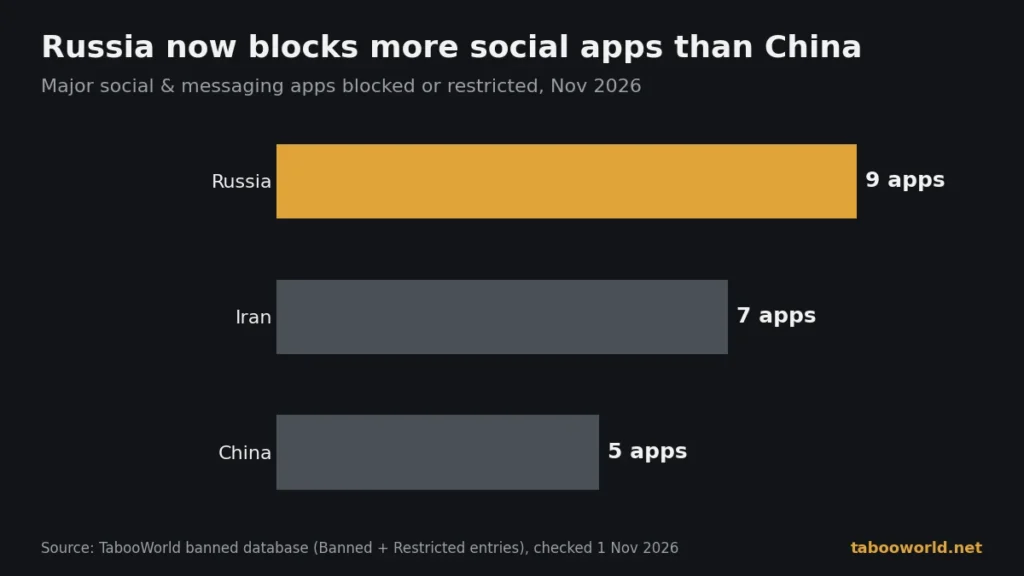
The result surprises many readers: Russia now blocks more major Western platforms than China does. China blocked its list early and then stopped, because domestic apps had already replaced the foreign ones. Russia started late and is still adding to its list in 2026.
| Platform | China | Iran | Russia |
|---|---|---|---|
| Blocked (2009) | Blocked (2009) | Blocked (2022) | |
| Blocked (2014) | Blocked (2022) | Blocked (2022) | |
| X (Twitter) | Blocked (2009) | Blocked (2009) | Not in our database |
| YouTube | Blocked (2009) | Blocked (2012) | Blocked (2026) |
| Blocked (2017) | Restricted (2025) | Blocked (2026) | |
| Telegram | Not in our database | Blocked (2018) | Blocked again (2026) |
| TikTok | Not in our database | Blocked (2019) | Not in our database |
| Signal, Viber, Discord | Not in our database | Not in our database | Blocked (2024) |
| Not in our database | Not in our database | Blocked (2016) |
“Not in our database” means we have not yet published a verified entry, not that the platform works freely. We add entries only after checking official or reliable sources.
This is the fastest-growing kind of social media ban, and it works very differently. The apps stay online for adults. Instead, platforms must verify ages and close accounts that belong to children, or face large fines. Children and parents are not punished.
France’s parliament approved an under-15 ban in July 2026, but the Constitutional Council struck it down on August 14, ruling it too broad. The EU, Denmark, Spain, Norway, New Zealand, Canada and the Philippines all have proposals in progress. In the United States there is no national ban, but states such as Florida limit accounts for younger teens. France also already restricts phones in schools for under-15s.
Early evidence is mixed. Australia’s eSafety Commissioner said in its first compliance report, in March 2026, that many under-16s still had accounts or could open new ones. A study reported in June 2026 found that about four in five Australian under-16s were still using social media. Supporters say the bans shift responsibility onto platforms and will tighten over time; critics say they push children toward fake ages, VPNs and less-moderated apps, and force adults to hand over ID.
Looking across every social media entry in our database, almost every ban falls into one of six patterns:
The first five patterns target speech and control. Only the sixth is aimed at protecting children, which is why human rights groups treat the two kinds of ban very differently.
Many bans don’t last. Public anger, court rulings or a deal with the platform can bring access back, sometimes within days.
No. No major social media platform is banned nationwide in the US. The closest case was TikTok, which briefly went offline in January 2025 before a new ownership deal. What the US does have is a patchwork of state laws on teen accounts, and federal bills such as the Kids Online Safety Act that are still being debated in Congress.
In countries with blanket blocks, foreign apps generally won’t load on local networks. Many visitors use roaming data or a VPN, but VPN rules differ by country and unauthorised use can be illegal. Check your own government’s travel advice before you go, and don’t assume an app that works at the airport will work in the city.
Key takeaways
We update this page whenever a ban starts, changes or ends. To see every app and website restriction in one place, filter our database by Apps & Websites, or compare full country lists for China and Iran. If you’re curious about bans beyond tech, the full banned-around-the-world list covers books, food, products and laws in 28 countries.
North Korea is the only country where ordinary citizens have no access to the global internet at all; they can only use a state intranet. China, Iran and Russia block most major Western platforms but allow domestic or state-approved alternatives, so social media itself still exists there.
Australia was the first country to enforce a national ban, which took effect on December 10, 2025, for under-16s. Platforms such as Facebook, Instagram, TikTok, Snapchat, X and YouTube must stop children from holding accounts, and the maximum fine is now A$99 million.
Yes. Russia’s regulator removed WhatsApp from the national DNS on February 12, 2026, and the Kremlin told users to switch to Max, a state-backed messenger. Signal, Viber and Discord were already blocked in 2024, and Telegram has faced new restrictions since February 2026.
Yes. YouTube has been largely inaccessible in mainland China since March 2009, after earlier intermittent blocks. It is also blocked in Iran, Russia, North Korea and Turkmenistan, while Pakistan restored access in 2016 after a four-year block.
Not yet. The UK government announced in June 2026 that under-16s will be barred from platforms including Snapchat, TikTok, YouTube, Instagram, Facebook and X. The rules are expected to take effect in spring 2027, so children can still hold accounts for now.
Nepal blocked 26 platforms in September 2025 because they had not registered with the government under new rules. The ban triggered Gen Z protests in which 19 people were killed, and the government lifted it on September 9, 2025.
This page is for general information and is not legal or travel advice. Laws change often; check official government sources before you travel or act on this information.
Listen to this article 1× France on November 9, 2026 publicly accused Iran’s Islamic Revolutionary Guard Corps of the October 11‑12 cyberattack that crippled…
Listen to this article 1× Quick answer Key Takeaways 5StarsStocks.com is a stock blog, not a licensed advisory firm, broker, or paid rating tool.…
Listen to this article 1× Australia has removed 27 apps from the Google Play Store and 19 from the Apple App Store between January…
2 comments