






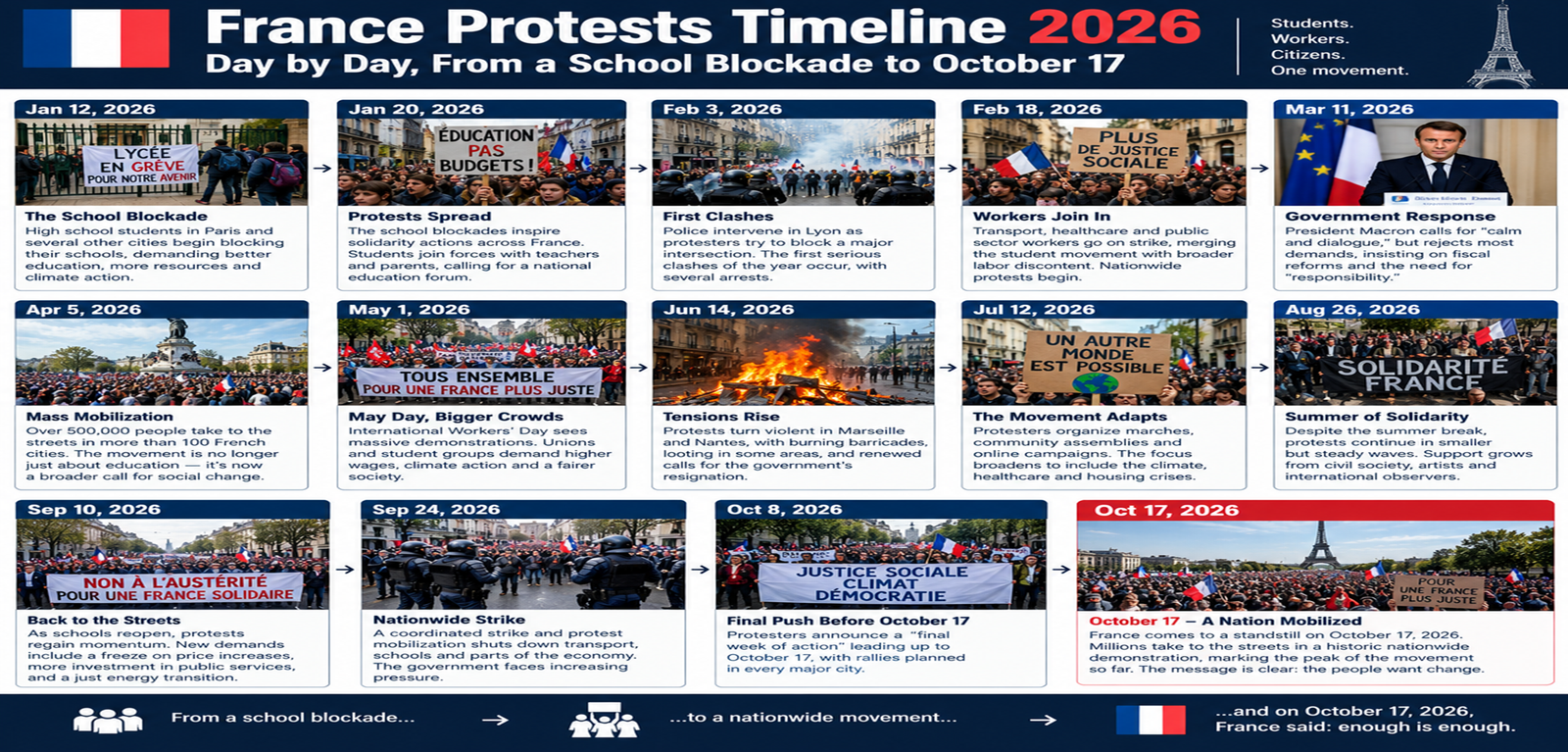
It started with one school in a Paris suburb and ended, at least for now, with a burning town hall in Limoges. In about a month, the 2026 France protests went from a local complaint about teachers and crumbling classrooms to the biggest street mobilisation of Emmanuel Macron’s final year in office. This page tracks […]
It started with one school in a Paris suburb and ended, at least for now, with a burning town hall in Limoges. In about a month, the 2026 France protests went from a local complaint about teachers and crumbling classrooms to the biggest street mobilisation of Emmanuel Macron’s final year in office.
This page tracks what happened, date by date. If you want the bigger picture of why it is happening and who is on which side, read our main guide: France Protests 2026: Why Students, Workers and Yellow Vests Are on the Streets.
The Short Version
- Mid-September: Students at a Créteil high school protest over missing teachers and run-down buildings.
- Late September to early October: Blockades spread to hundreds of schools. Arrests climb into the thousands, most of them minors.
- October 6 and 13: Two national days of action bring out hundreds of thousands, depending on who is counting.
- October 17: Students, unions and former Yellow Vests march together. Fires, looting and a record number of arrests follow.
Mid-September: A Strike at One School
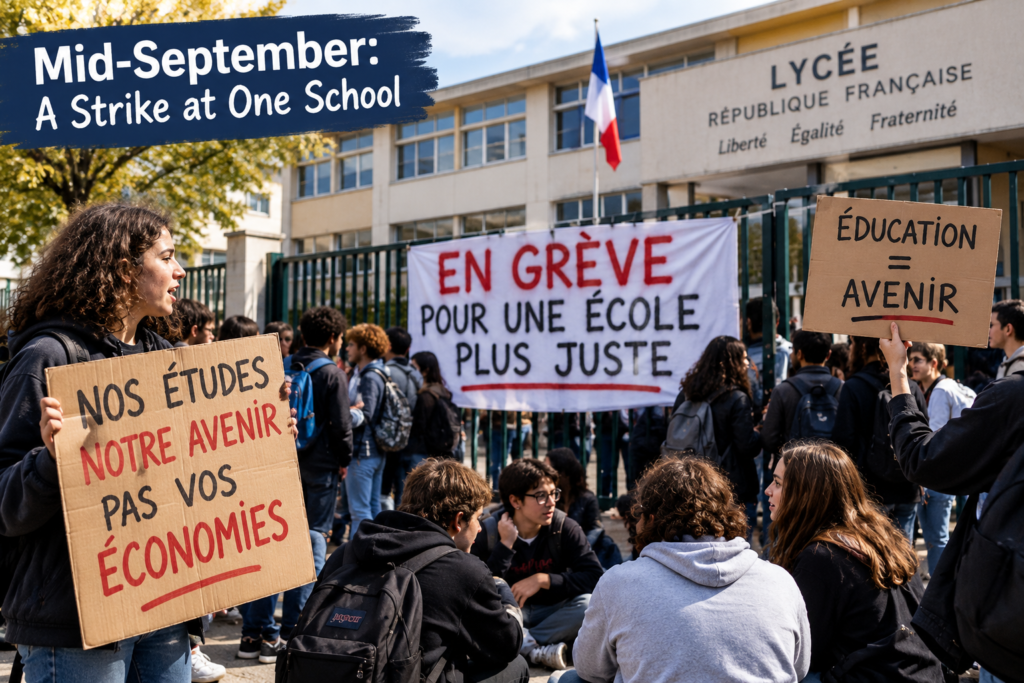
The protests began in mid-September at a high school in Créteil, a suburb of Paris, where students took to the streets over dilapidated buildings, overcrowded classrooms and teacher shortages. Pupils at Lycée Saint-Exupéry joined striking teachers. Extra staff were sent and that particular strike ended, but the idea had already travelled. Students in other towns copied it.
September 28 to October 5: Blockades Spread
On September 28, Prime Minister Sébastien Lecornu warned that escalation would be “irresponsible,” pointing to fireworks and fires near schools. The next day, public-sector workers struck over budget cuts, and police detained more than 400 people during student protests, many of them minors.
By October 1 the Interior Ministry counted 1,949 arrests. Lecornu held a crisis meeting and told ministers to cancel their travel. Protests were recorded at about 1,020 of France’s roughly 3,700 lycées by October 2, and the government banned demonstrations near closed schools.
October 5 was the darkest day of this stretch. In Lens, a 15-year-old boy lost his hand to a police grenade. Over 700 secondary schools were disrupted and roughly 5,000 people had been arrested.
October 6: The First Big National Day
On Tuesday, October 6, the Interior Ministry put turnout at about 260,000, while organisers claimed up to 450,000. By that evening the Justice Ministry said 5,060 people had been arrested since the protests began, and 87% of them were minors.
Lecornu told ministers to answer the students’ main demands and bring initial proposals by the end of October.
October 7 and 8: First Concessions
On October 7 the government suspended stun grenades for student protests. Macron asked police to show more empathy toward young protesters.
On October 8, Education Minister Édouard Geffray said on TF1 that 3,000 substitute teachers would be sent to cover absences in around 500 lycées in a critical situation. Student unions were not impressed. Their spokesperson said the movement would carry on until 10 billion euros were “on the table”, and one union called the first offers “crumbs.”
Lecornu said that day that 6,629 people had been detained since September 28, and that 215 students, 89 teachers and 761 police officers and gendarmes were injured.
Turnout on the 8th fell sharply, to somewhere between roughly 71,000 and 130,000 in the figures reported. Some people in government hoped the movement was running out of steam. It was not.
October 13: The Movement Comes Back Stronger
Tuesday, October 13 was the fifth major day of action. According to the Interior Ministry, 161,500 people marched, 41,500 of them in Paris. Organisers said 480,000. The student union Union Étudiante said around 90% of French universities were disrupted by blockades or other actions.
Swedish climate activist Greta Thunberg voiced support for the students. Macron called for restraint and dialogue from all sides.
The gap between the two turnout figures is worth remembering. It shows up again four days later.
October 16: The Night Before
The next day of action was set for Saturday, October 17, and this time it was not only about schools. A call to revive the Yellow Vests, driven by anger over fuel prices and the cost of living, had been spreading online. Yellow Vest figures such as Jérôme Rodrigues and Priscillia Ludosky said openly that they did not know how big it would be. Rodrigues also pushed back on the label, saying no Yellow Vest was behind the call.
Macron said the student protesters were being “exploited” by political forces, and the government blamed the hard-left LFI, which denies it. Lecornu said the unrest had been among the most violent in decades, with more than 900 police injured since it began. Interior Minister Laurent Nuñez warned that stun grenades could still be used on Saturday if there were clashes. The authorities expected around 200,000 people.
October 17: Fires, Looting and a Record
The day opened peacefully. Crowds sang the national anthem and waved flags. Then it turned. In Paris, cars were set on fire, shops were looted, and police used tear gas and water cannons.
The violence was not limited to the capital:
- Lyon: about 20,000 people marched, and a fire broke out inside a tourist office.
- Marseille: protesters got into the town hall and shops were looted.
- Limoges: masked protesters broke into the town hall and set it on fire, and the spire collapsed.
The Interior Ministry said around 550,000 people took part, about 110,000 of them in Paris. The CGT union claimed roughly 800,000. Paris police made 855 arrests, a record. The prime minister later said 1,200 people were arrested nationwide and 150 police officers were hurt.
Macron blamed “sowers of chaos” and promised that anyone who attacked police stations, businesses or town halls would be prosecuted.
Turnout at a Glance
| Date | Interior Ministry | Organisers or unions |
|---|---|---|
| October 6 | About 260,000 | Up to 450,000 |
| October 13 | 161,500 | 480,000 |
| October 17 | About 550,000 | About 800,000 (CGT) |
Official and organiser counts rarely match in France. Treat both as claims, not facts, and look at the trend instead.
What Is Still Unresolved
As of October 18, there is no settlement. Three things to watch:
- The end-of-October package. Lecornu promised initial responses by then. Students want a 10 billion euro plan.
- The 2027 budget debate. Education funding and the public-sector pay freeze could calm things or reignite them.
- Prosecutions after October 17. With over a thousand arrests, court cases could become the next flashpoint.
We will update this timeline as new official figures come out. For the causes, the police controversy and the government’s full response, go back to our main France protests guide.


4 Comments