





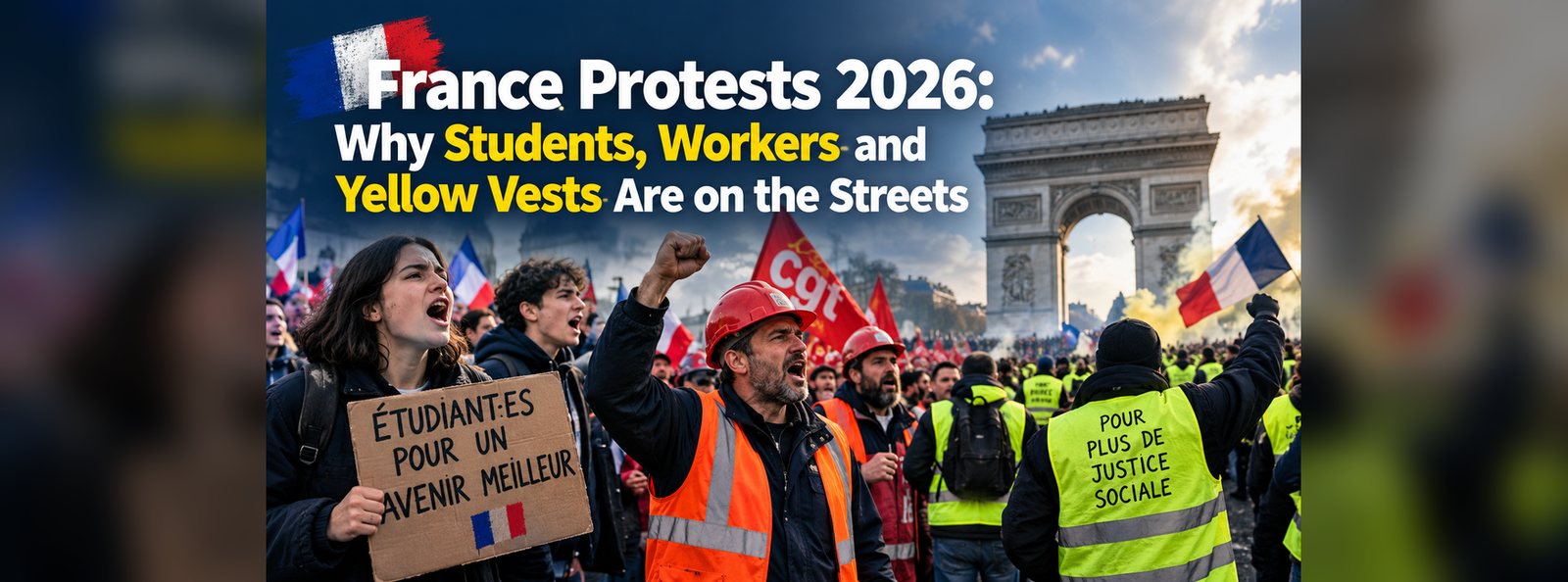
France's protests began as school blockades in mid-September and merged with Yellow Vest cost-of-living marches on October 17. Officials reported 550,000 protesters and 1,200 arrests that day. Here are the causes, the conflicting numbers and what could happen next.
The France protests 2026 began as a school problem and turned into a national crisis. In mid-September, high school students in a working-class suburb of Paris blocked their school over teacher shortages and crumbling buildings. Within weeks the movement had spread to thousands of schools and dozens of universities. On October 17 it merged with a cost-of-living revolt led by unions and returning Yellow Vests, and the streets of Paris, Lyon, Marseille and Limoges saw fires, looting and record arrests. This guide explains what is happening, why, who says what, and what could come next.
Key Facts at a Glance
- On October 17, the interior minister said about 550,000 people protested across France, including 110,000 in Paris. The CGT union claimed around 800,000.
- Paris police arrested a record 855 people that day. The prime minister said 1,200 people were arrested nationwide and 150 police officers were hurt.
- Between September 28 and October 8, 6,629 people were detained, and 215 students, 89 teachers and 761 police officers and gendarmes were injured, according to Prime Minister Sébastien Lecornu.
- By October 5, student protests had disrupted over 700 secondary schools and led to roughly 5,000 arrests.
- Masked protesters broke into the town hall in Limoges and set it on fire, and its spire collapsed.
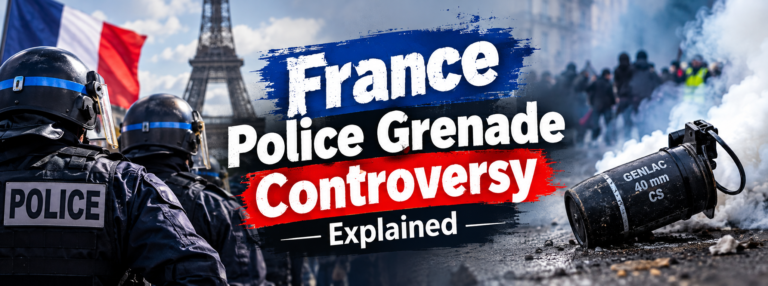
- A 15-year-old boy had his hand blown off by a police grenade during a protest in Lens, and the government suspended stun grenades for student protests.
- Solidarity protests took place in Belgium, Albania and Italy.
What Are They Protesting in France Now?
Two connected protests are running together. The first is a student-led movement against underfunded schools. The second is a cost-of-living protest backed by unions and Yellow Vest activists. On October 17 they joined forces. The movement now unites high school and university students, teachers, parents, unions, farmers, climate activists and former Yellow Vests.
Their demands include:
- Smaller classes, more teachers and better school buildings.
- An end to police violence against young people.
- Lower fuel prices and relief from the high cost of living.
- Higher wages and pensions, and protection of public services.
- An end to frozen benefits and public-sector salaries in the draft budget.
Why Are Protesters in France? The Five Main Reasons
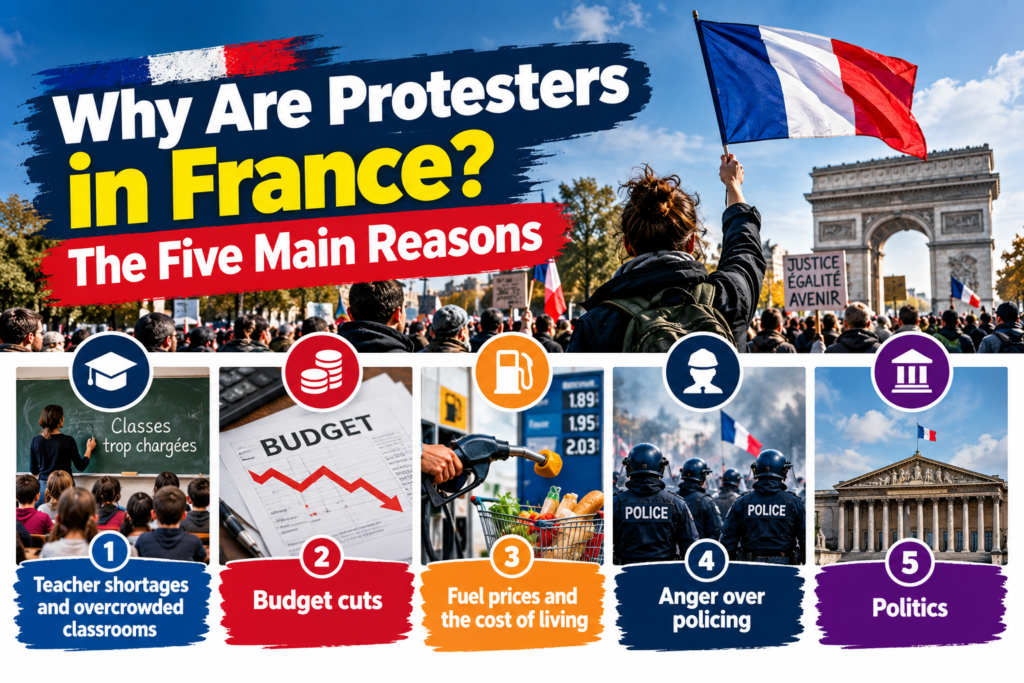
1. Teacher shortages and overcrowded classrooms. Students say teachers are missing, classes have 32 to 35 pupils, timetables are long and buildings are run-down.
2. Budget cuts. The school protests started at the same time as public-sector strikes over the government’s planned budget cuts.
3. Fuel prices and the cost of living. Unions and Yellow Vest supporters are protesting rising fuel prices, linked to the US-Israeli war on Iran, and pressure on household finances.
4. Anger over policing. The protests have unfolded amid growing criticism of how police handled the student demonstrations.
5. Politics. The unrest adds pressure on President Emmanuel Macron’s government ahead of the 2027 presidential election.
What Are the French Student Protests About?
The student protests are about the condition of French public schools. Students cite missing teachers, classes of 32 to 35 pupils, long timetables, run-down buildings, stress linked to the Parcoursup university application website, and classroom temperatures that reached 40°C during the 2026 European heatwaves.
The first protest was small. In mid-September, pupils at Lycée Saint-Exupéry in Créteil, a Paris suburb, joined striking teachers over missing staff and resources. The strike ended when extra staff were sent, but by then the match had been lit. Student leaders say the movement spread like wildfire.
The grievances are long-standing: an overcrowded, ill-equipped and understaffed education system that many students feel is no longer fit for purpose. Their demands include smaller classes, more spending on teachers, safer and climate-resilient school buildings, and an end to police violence against young people.
What Is the Riot in France About?
The riots grew out of the protests, not the other way round. Some school blockades turned violent in late September, with protesters burning rubbish bins and throwing bottles at officers, who responded with batons and tear gas. In Nantes, Lycée Nelson Mandela was burned.
On October 17 the violence moved to city centres, after what had been largely peaceful marches. The Interior Ministry said masked groups using “black bloc” tactics attacked police and damaged public buildings and street furniture. The government blames the hard left. Critics say the unrest reflects deep frustration over school conditions, living costs and heavy-handed policing.
Timeline: How the Crisis Unfolded
- Mid-September: Students at Lycée Saint-Exupéry in Créteil protest alongside striking teachers. The movement spreads across the Paris region.
- September 29: Public-sector workers strike over budget cuts. Police detain more than 400 people during student protests, many of them minors.
- October 1: The Interior Ministry reports 1,949 arrests. About 340 demonstrations take place outside high schools, over 160 schools are shut, and students block around 30 university campuses.
- October 2: Protests are recorded at about 1,020 of France’s roughly 3,700 lycées, and the government bans demonstrations near closed schools. More than 400 schools are closed, some moving to online classes.
- October 5: Over 700 secondary schools are disrupted and roughly 5,000 people have been arrested. In Lens, a 15-year-old boy loses his hand to a police grenade.
- October 6: A national day of mobilisation draws more than a quarter of a million people, according to government figures. Lecornu announces a “period of internal democracy” in schools.
- October 7: The government suspends stun grenades for student protests.
- October 8: Education Minister Edouard Geffray pledges 3,000 additional teachers. Lecornu says 6,629 people have been detained since September 28.
- October 13: Students demonstrate again, backed by teachers, parents and unions.
- October 17: Yellow Vests, unions and students march together. Clashes, fires and looting hit Paris, Lyon, Marseille, Limoges and other cities.
- Full day-by-day version: France Protests Timeline 2026
October 17: Fires, Looting and Record Arrests
The day began mostly peaceful, with crowds chanting the national anthem and waving flags. Then the mood changed. In Paris, cars were set on fire and shops looted, while police used tear gas and water cannons to disperse violent protesters.
The violence spread beyond the capital. In Lyon, where about 20,000 protesters marched, a fire broke out inside a tourist office. In Marseille, demonstrators breached the town hall and looted shops. In Limoges, masked protesters broke into the town hall and set it on fire, causing the spire to collapse.
President Macron blamed “sowers of chaos” for interfering with peaceful protests and promised that those who attacked police prefectures, businesses and town halls would be prosecuted. Prime Minister Lecornu backed the police and said they faced extreme violence.
The Numbers: Who Says What
Every outlet reports different figures. Here they are side by side.
| What | Figure | Who says |
|---|---|---|
| October 6 turnout | More than 250,000 | Government figures (via NPR) |
| October 6 turnout | More than 160,000 | TIME |
| October 17 turnout | 550,000 (110,000 in Paris) | Interior Minister Laurent Nuñez |
| October 17 turnout | 800,000 | CGT union |
| October 17 arrests (evening) | About 400, mostly adults | Interior Minister |
| October 17 arrests (Paris only) | 855, a record | AP |
| October 17 arrests (nationwide) | 1,200, with 150 police hurt | Prime Minister Lecornu |
| Detained Sept 28 to Oct 8 | 6,629 | Prime Minister Lecornu |
| Injured Sept 28 to Oct 8 | 215 students, 89 teachers, 761 police and gendarmes | Prime Minister Lecornu |
| Injured by mid-October | Over 200 students, 85 school staff, 700 police | TIME |
Why the numbers differ: governments and unions count crowds in different ways, and arrest totals kept rising through the night. Treat arrest figures as snapshots, not contradictions. We update this table as new official figures are released.
Police Under Fire
The police response has become a story of its own. The government suspended stun grenades for student protests after a 15-year-old boy had his hand blown off during a clash with riot police. Macron asked police to show empathy and more pedagogy towards student protesters, and the interior minister banned one type of police grenade. For the full story of what happened in Lens and what is still disputed, see our explainer: Police Grenade Controversy Explained.
The government rejects claims of repression. Interior Minister Nuñez said the police response was proportionate in almost all cases, and Lecornu called allegations that police are racist a lie, while promising that any accidents would be investigated. Lecornu also denied that police were told to crack down on teenage protesters.
Critics disagree. A far-left France Unbowed lawmaker pointed to riot police, batons, rubber bullets and tear gas. Many protesters say it makes no sense to hit minors.
How the Government Responded
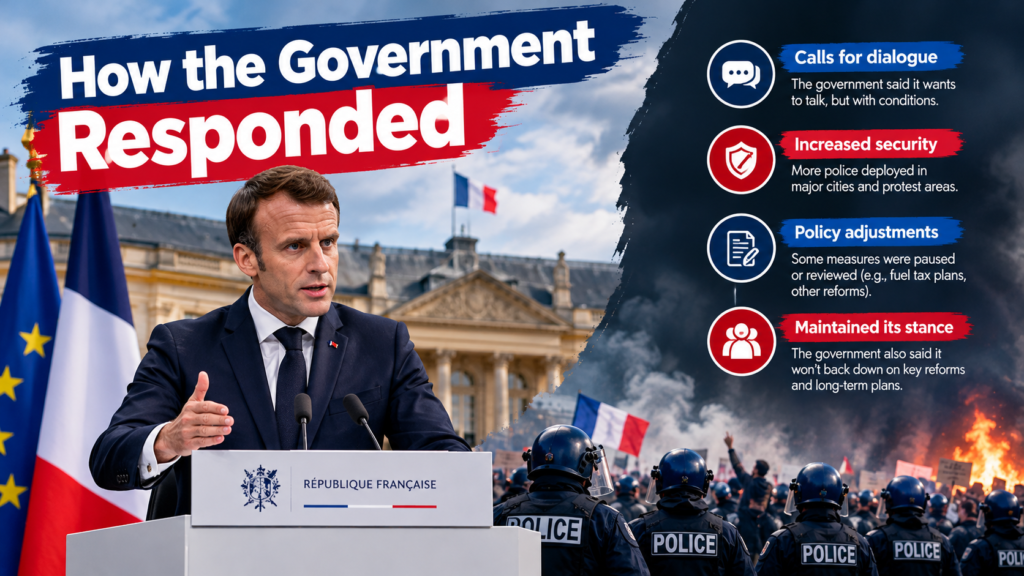
- More teachers: Education Minister Geffray pledged that 3,000 additional teachers would be deployed within days. Student unions dismissed the package as an empty gesture.
- Listening period: Lecornu said lessons would be replaced for the rest of that week with a period of internal democracy, so pupils could air grievances and discuss solutions.
- Budget changes: Lecornu said the government would table amendments to the 2027 budget to turn some pupils’ proposals into concrete measures. Education already gets the second-largest funding increase after defence, up 1.4 percent to 90.9 billion euros. Economy Minister Roland Lescure said there was room to meet demands for more school resources.
- Student demand: Students want about $11 billion in funding and faster action than the response package Lecornu promised by the end of October.
- Political blame: Lecornu accused the left-wing party LFI of stoking the protests with a political agenda ahead of the 2027 presidential election.
What Is Confirmed and What Is Disputed
Confirmed (reported by officials and several outlets):
- A 15-year-old boy lost his hand to a police grenade, and the government suspended stun grenades for student protests.
- The government pledged 3,000 additional teachers.
- Hundreds of people were arrested on October 17, and several public buildings, including a town hall in Limoges, were attacked.
Disputed (depends on who you ask):
- Who is to blame for the violence. The government says ultra-left groups orchestrated violence and delinquents joined in to pillage. Critics argue the government’s only concrete answer has been a heavy-handed police response.
- Police racism. Protesters allege it. Lecornu calls the allegation a lie.
- The teacher package. Ministers say it addresses the problem. Student unions call it an empty gesture.
- Turnout. 550,000 according to the interior minister, 800,000 according to the CGT.
The Yellow Vests Return
The Yellow Vest movement began in 2018, motivated by rising fuel prices, a high cost of living and economic inequality. It faded during the COVID lockdowns. Its return could give the school protests a much longer lifespan.
For October 17, Yellow Vest figures Jerome Rodrigues, Priscillia Ludosky and Maxime Nicolle called on people to join, backed by the CGT union, France Unbowed and the French Communist Party. The CGT called for higher wages and pensions, lower prices and the protection of public services. Protesters in high-visibility vests blocked streets in Paris, recalling the movement that marked Macron’s previous term.
Why 2026 Is Different
| Movement | Trigger | What happened |
|---|---|---|
| 1968 | Student protest | Grew into the largest strike in French history |
| 2006 | Job-contract law | About 500,000 people protested; the government withdrew the contested part of the law |
| 2018 Yellow Vests | Fuel prices, cost of living | Peaked at 287,710 protesters according to the Interior Ministry |
| 2022 | Cost of living | 107,000 according to the interior ministry, over 300,000 according to other estimates |
| 2025 “Bloquons tout” | Budget cuts | Opposed a budget proposing €43.8 billion in public spending cuts; largely peaceful |
| 2026 | Schools, fuel prices, budget | Students, unions and Yellow Vests together; 550,000 on October 17 according to the interior minister |
What makes 2026 different: TIME’s analysis says France has never seen so many violent incidents in a movement made up largely of high school students. It is also the first time in years that students, unions and Yellow Vests have marched together, which is why analysts think this one could last longer.
Full comparison: France 2026 vs Yellow Vests 2018
Why This Is Dangerous for Macron
Student protests have a record of hurting French governments. The 1968 student protest turned into the largest strike in French history.
The government is also squeezed. It is caught between demands for better-funded public services and the need to rein in France’s debt. Spending more risks the budget. Cracking down risks more anger. With a presidential election approaching, every concession and every clash becomes political.
What Happens Next?
The reports reviewed show no settlement as of October 18. Three things to watch:
- The end-of-October package. Lecornu promised a response by then, and students want it sooner.
- The 2027 budget debate. Amendments on education funding and the public-sector pay freeze could calm or inflame the streets.
- New protest dates. Student groups and unions have repeatedly called fresh days of action, and prosecutions after October 17 could add fuel.
What This Means for You
General guidance. Always check your UK government’s latest travel advice.
If you are travelling to France
- Expect disruption in city centres on protest days. On October 17, police used tear gas and water cannons in Paris.
- Avoid large gatherings, especially around major squares and town halls, and check local news before moving around.
- Carry ID, keep your phone charged and confirm transport the same day.
If you are a student or parent
- Many schools have been disrupted, and some have moved to online classes.
- Follow your school’s official channels, not social media rumours.
If you live in France
- Watch for new strike calls from unions and student groups, and for the government’s education package promised by the end of October.
Glossary: Terms Used in This Story
- Lycée: upper secondary school; students are typically 15 to 18.
- CGT: France’s biggest trade union.
- LFI (France Unbowed): the largest single left-wing party in parliament.
- Parcoursup: the university application website that students cite as a source of stress.
- Black bloc: masked groups using confrontational tactics, including attacks on police and damage to property.
- Gilets jaunes (Yellow Vests): the grassroots movement that began in 2018 over fuel prices and the cost of living.
- CRS: France’s riot police, the Republican Security Corps.
FAQ
What are they protesting in France now? Underfunded schools, teacher shortages, budget cuts, high fuel prices, the cost of living and police violence.
Why are protesters in France? School conditions started it. Fuel prices, frozen pay and benefits, and anger at police tactics widened it.
What are French student protests about? Overcrowded classes, missing teachers, run-down buildings and long timetables. Students want more funding and more teachers.
What is the riot in France about? The riots are violent outbreaks on the edges of the protests. The government blames far-left groups, while critics point to police tactics and deep frustration over living costs and public services.
Are the Yellow Vests back? Yes. Original Yellow Vest figures joined the October 17 protests.
How many people have been arrested? Figures keep rising. By October 8 the government had counted 6,629 detentions since September 28, and on October 17 the prime minister reported 1,200 more arrests nationwide.
Did a teenager lose his hand to a police grenade? Yes. A 15-year-old boy had his hand blown off during a protest in Lens, and the government suspended stun grenades for student protests afterwards.
Will the protests continue? No settlement had been announced as of October 18. Watch the end-of-October education package, the 2027 budget debate and new protest calls.
Is it safe to travel to France? No government has told people to avoid France, but protests, school closures and clashes have been reported in Paris, Marseille, Lyon and other cities. Check your government’s latest travel advice and read our full travel safety guide.
Sources
- Al Jazeera: What’s behind French student protests that turned violent
- Al Jazeera: Protests rock France as government pledges 3,000 extra teachers
- Al Jazeera: Tear gas and unrest as hundreds of thousands protest in France
- CNN: Unprecedented student protests are rocking France
- CNN: French students say they’re just getting started
- CNN: Buildings torched and over 1,000 detained after half a million protesters sweep France
- NPR: France’s police fire tear gas and water cannons as school protests sweep the country
- France 24: Chaotic scenes as organisers of French protests claim 800,000 have taken to streets
- France 24: French government vows to boost teacher numbers
- CBS News / AP: French police arrest 855 people in Paris as protests, violence erupt across country
- TIME: Why is France Burning?
- Euronews: France braces for tense protests as security concerns take centre stage
- Connexion France: Clashes erupt as protests spread across France
- Bernama-Anadolu: France braces for nationwide cost-of-living protests
- Wikipedia: 2026 French student protests
- Wikipedia: Yellow vests protests
- Wikipedia: Bloquons tout


4 Comments