





If you have a ticket to France this month, the honest answer is uncomfortable: you can still go, but you would be going into the worst unrest the country has seen in years, during one of its busiest holiday weeks, with flights and trains at risk of strikes. Paris, Lyon, Marseille and Limoges all saw […]
If you have a ticket to France this month, the honest answer is uncomfortable: you can still go, but you would be going into the worst unrest the country has seen in years, during one of its busiest holiday weeks, with flights and trains at risk of strikes.
Paris, Lyon, Marseille and Limoges all saw fires, looting and clashes on October 17. Police made a record 855 arrests in Paris alone. No government has told its citizens to stay away. But “not banned” is not the same as “safe,” and this page lays out the difference.
For the background, read our France protests guide and the day-by-day timeline.
The Short Answer
- No major government has issued a “do not travel” warning for France. The US still lists it at Level 2, “exercise increased caution.”
- The risk is real and concentrated in cities. Violence has hit Paris, Lyon, Marseille and Limoges.
- The biggest practical danger for most tourists is disruption, not personal attack: blocked streets, cancelled flights, reduced trains, closed attractions.
- The situation is unresolved. There is no settlement, and a government package is not due until the end of October.
What Happened on October 17
The day began peacefully, then turned. In Paris, cars were set on fire and shops were looted, and police used tear gas and water cannons. In Lyon, a fire broke out inside a tourist office. In Marseille, protesters broke into the town hall. In Limoges, masked protesters set the town hall on fire and its spire collapsed.
Reuters-reported coverage described rioting in cities across France as some of the worst violence in decades, with violent fringe groups targeting public buildings, looting luxury boutiques and supermarkets, and attacking police vehicles and officers. The prime minister said 1,200 people were arrested nationwide and 150 police officers were hurt.
That is the setting any visitor is stepping into right now.
What Governments Are Saying
United States. The State Department keeps France at Level 2, warning of terrorism and civil unrest. That advisory was issued before the latest protests and has not been raised. Separately, the US Embassy issued a demonstration alert on October 5 saying student protests had turned violent in places and telling Americans to avoid demonstration areas and allow extra travel time.
United Kingdom. The Foreign Office has no specific warning about the current protests. Its general page says industrial action, demonstrations and marches can happen with little or no warning, and tells travellers to monitor the media and follow the authorities’ advice.
Private security firms. Travel risk company iPMI Global told clients to avoid schools and protest sites and expect sudden transport delays, naming Paris, Marseille, Lyon, Toulouse, Lille, Strasbourg, Nantes and Rennes.
A word of warning about these advisories: they were written before October 17 and tend to lag behind events. Check your own government’s page again before you fly, because it can change quickly.
Five Real Risks for Travellers
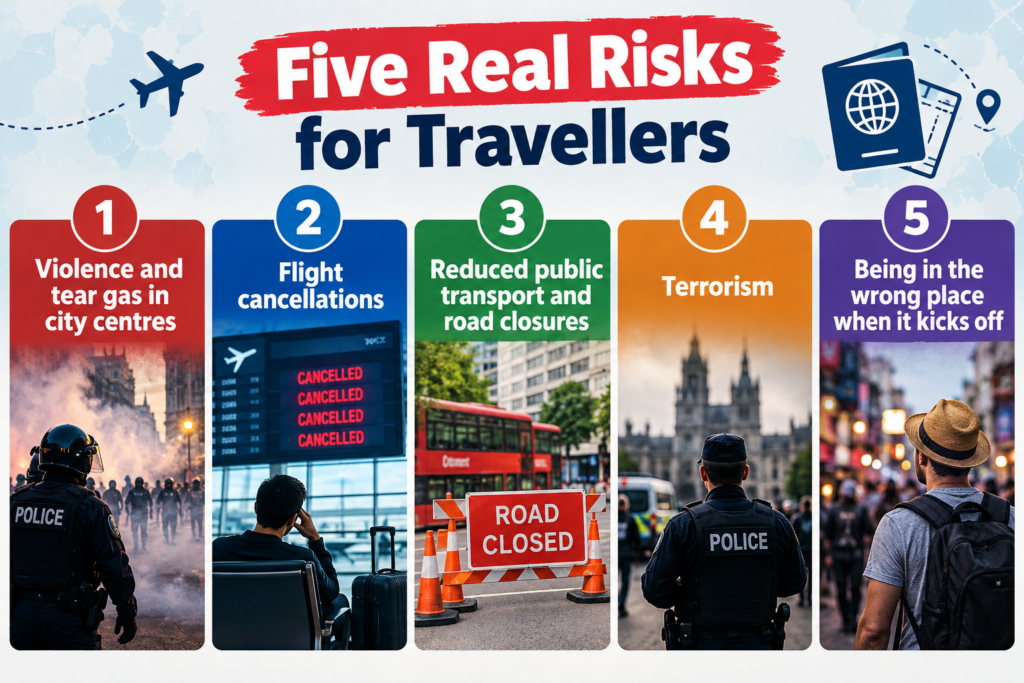
1. Violence and tear gas in city centres. Protests that start peacefully have turned violent within hours. Police have used tear gas and water cannons in Paris, Strasbourg, Rennes and Toulouse. Bystanders get caught in this too, not only protesters.
2. Flight cancellations. A national strike notice covering French pilots and cabin crew runs from October 17 to 21, timed with the start of the Toussaint school holidays. Air France, Transavia France, Volotea and Corsair were expected to be hit hardest, and airlines that use French-based crews, such as easyJet and Ryanair, could also face cancellations. That notice was filed as a possibility and unions said they were open to talks, so check your airline directly for the latest status.
3. Reduced public transport and road closures. Travel Weekly reported that travellers should expect reduced public transport and more road closures during the protest weeks. On strike days, rail, bus and air service can drop sharply.
4. Terrorism. The US advisory says terrorist groups continue to plan possible attacks in France and may strike with little or no warning. This is a standing warning that predates the protests, but it matters more when police resources are stretched.
5. Being in the wrong place when it kicks off. The usual protest hotspots in Paris are squares such as Bastille, République and Concorde. These are also places tourists walk through. Police charges, blocked metro exits and sudden crowd movement can happen with no notice.
Which Cities Are Most Affected
| City | What happened |
|---|---|
| Paris | Record 855 arrests on October 17, burned cars, looted shops, tear gas and water cannons |
| Lyon | About 20,000 marched, fire inside a tourist office |
| Marseille | Town hall breached, shops looted |
| Limoges | Town hall set on fire, spire collapsed |
| Strasbourg, Rennes, Toulouse | Tear gas and water cannons used during earlier protests |
Who Should Think Twice
You should seriously reconsider or build in a lot of flexibility if:
- You are flying between October 17 and 21. The crew strike could cancel your flight or strand you.
- You are travelling with young children, elderly relatives or anyone with limited mobility. Sudden road closures and crowd surges are harder to handle.
- You have a tight connection or a non-refundable booking. A single cancelled flight can cascade.
- You are planning to attend a big event. The NFL game at Stade de France on October 25 is the most visible example, and fans are already asking whether it is safe.
- You plan to be near government buildings, squares or school campuses in a major city.
If You Are Going Anyway
This is general guidance, not a guarantee of safety. Always check your own government’s latest travel advice first.
- Register with your embassy’s alert system. US citizens can enrol in STEP to get updates.
- Check protest dates before every outing. Unions and student groups have called new days of action repeatedly.
- Stay away from demonstrations. Do not stop to film or watch. Leave the area if tear gas is used.
- Keep your plans flexible. Book refundable hotels and flights where you can, and keep your airline app open.
- Carry ID and a charged phone, and know your embassy’s contact number.
- Use the news the same day. Local outlets and official channels move faster than blog posts, including this one.
The Bottom Line
France is not closed, and most visitors who stay away from protest areas will not come into direct contact with violence. But this is a country in the middle of an unresolved crisis, with unrest that has spread across the country, a flight strike on the calendar and no deal in sight. If you can postpone, many travellers will decide that is the safer call. If you can’t, go with a flexible plan and your eyes open.



One thought on “Is It Safe to Travel to France Right Now? What Tourists Are Walking Into”