




Lobbying is one of the most powerful and least understood forces in politics. It is legal, it is everywhere, and it divides opinion sharply. Here is how it works, who does it, and why it keeps sparking debate. What Is Lobbying? Lobbying means trying to influence lawmakers or government officials on a decision, such as […]
Lobbying is one of the most powerful and least understood forces in politics. It is legal, it is everywhere, and it divides opinion sharply. Here is how it works, who does it, and why it keeps sparking debate.
What Is Lobbying?
Lobbying means trying to influence lawmakers or government officials on a decision, such as a new law, a tax rule, or a spending bill. People who do this work are called lobbyists. They can represent companies, unions, charities, trade groups, or even foreign interests.
Lobbying is not the same as bribery. Lobbying is a legal activity with disclosure rules. Bribery means offering something of value in exchange for an official act, and it is a crime.
Who Lobbies?
- Corporations such as banks, drug companies, energy firms and tech giants
- Trade associations that speak for a whole industry
- Unions and professional bodies
- Non-profits and advocacy groups, including environmental and health charities
- Governments and state-linked groups from other countries
Lobbying is not just a “big business” activity, but business groups dominate the spending.
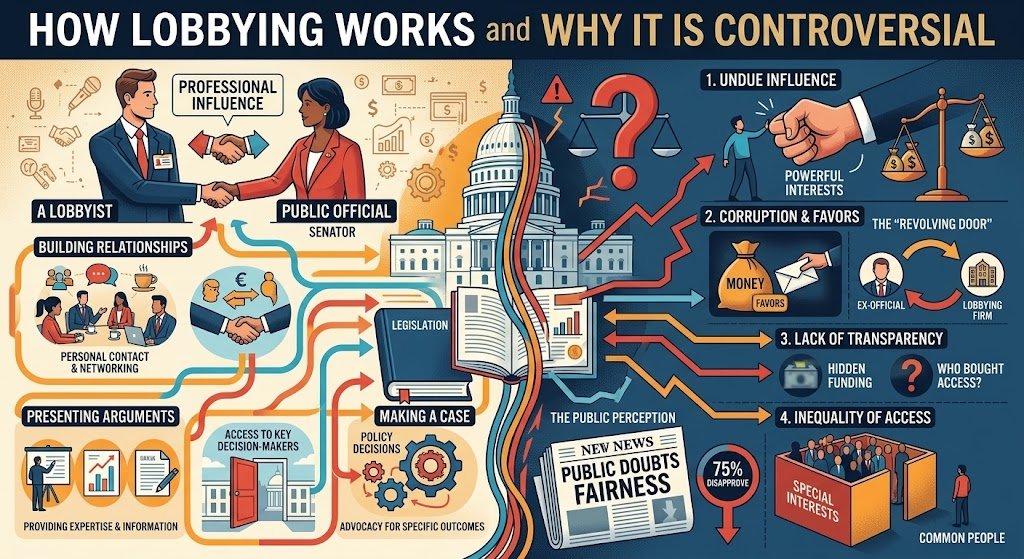
How Lobbying Actually Works
1. Direct contact. Lobbyists meet officials, send briefings, and give expert advice on how a rule would affect their client.
2. Writing and research. Lawmakers have limited staff, so lobbyists often supply data, draft amendments or even suggest bill language.
3. Grassroots campaigns. Groups mobilize voters to call, email or write to their representatives, so the pressure appears to come from the public.
4. Coalitions and trade groups. Many companies join forces so their message sounds broader and stronger.
5. Campaign money. In the US, groups also give to campaigns and political action committees (PACs), which critics say helps buy access.
6. The “revolving door.” Former officials become lobbyists, and lobbyists sometimes move into government. In the energy sector, for example, nearly half of the roughly 2,200 lobbyists working in early 2025 were former government employees, according to OpenSecrets data reported by Inside Climate News.
How Big Is Lobbying? The 2026 Numbers
In the United States:
- Federal lobbying spending hit a record $5.08 billion in 2025, according to OpenSecrets (Bloomberg Government’s separate count was $5.3 billion).
- 15,768 organizations reported lobbying, up from 14,061 the year before.
- The US Chamber of Commerce was the top single spender at $72.1 million.
- Health care was the biggest sector, at roughly $868 million.
- The most lobbied topics were the federal budget, taxes and health.
- Outside lobbying firms outspent in-house teams for the first time on record: $2.76 billion versus $2.46 billion.
- Seven of the biggest tech, AI and social media companies spent about $50 million combined in the first nine months of 2025.
Why Is Lobbying So Controversial?
Critics argue:
- Money buys access. Groups with deep pockets get more meetings and more influence than ordinary citizens.
- It tilts policy. Laws can be shaped to benefit a few powerful companies instead of the public.
- The revolving door creates conflicts of interest, since officials may be thinking about a future job.
- It is often hidden. Not all lobbying is reported, especially indirect or grassroots campaigns.
- Foreign influence can operate through lobbying firms with little public view.
Defenders argue:
- It is a form of free speech and the constitutional right to petition government (in the US).
- Lawmakers need expert information, and industries know their field best.
- Everyone can lobby, including charities, unions and patient groups.
- Disclosure laws already make most direct lobbying public.
Both views have a point. The real debate is about how much transparency and which limits are enough.
How Is Lobbying Regulated?
United States: Lobbyists must register and file regular reports on who they work for and how much is spent. Public databases like OpenSecrets track it.
United Kingdom: The Transparency of Lobbying Act 2014 created a register, but critics say it has big gaps. It covers only consultant lobbyists (not in-house staff), only contact with ministers and permanent secretaries, and exempts businesses not registered for VAT, which can include foreign firms. The register also does not show who was lobbied or about what. The official Registrar of Consultant Lobbyists has itself said that revealing who was lobbied would “significantly assist transparency.”
Possible Reforms
- Cover in-house lobbyists and all paid lobbying, not just consultants
- Publish who was lobbied, when and about what
- Cooling-off periods before officials can become lobbyists
- Stronger rules on foreign-linked lobbying
- Faster, open data so journalists and citizens can check the facts
Final Thoughts
Lobbying is neither purely good nor purely bad. It can bring useful expertise to lawmakers, but without strong transparency it can also drown out ordinary voices. With US spending at record levels, the question is no longer whether lobbying matters, but whether the rules are keeping up.
FAQ
Is lobbying legal?
Yes, in most democracies, as long as it follows disclosure rules.
What is the difference between lobbying and bribery?
Lobbying is legal persuasion. Bribery is offering something of value in exchange for an official decision, which is illegal.
What is the revolving door?
When people move between government jobs and lobbying or industry jobs.
How much is spent on lobbying in the US?
About $5 billion in 2025, a record, according to OpenSecrets.
Can ordinary people lobby?
Yes. Writing to or meeting your representative is a form of lobbying.
