
Listen to this article 1× Quick answer: American foods banned in other countries are mostly a myth at the brand level. No law we checked names Skittles, Ritz or Gatorade. Countries ban ingredients instead, such as titanium dioxide, potassium bromate and ractopamine. The 2026 twist runs the other way: the US now bans Red 3 […]
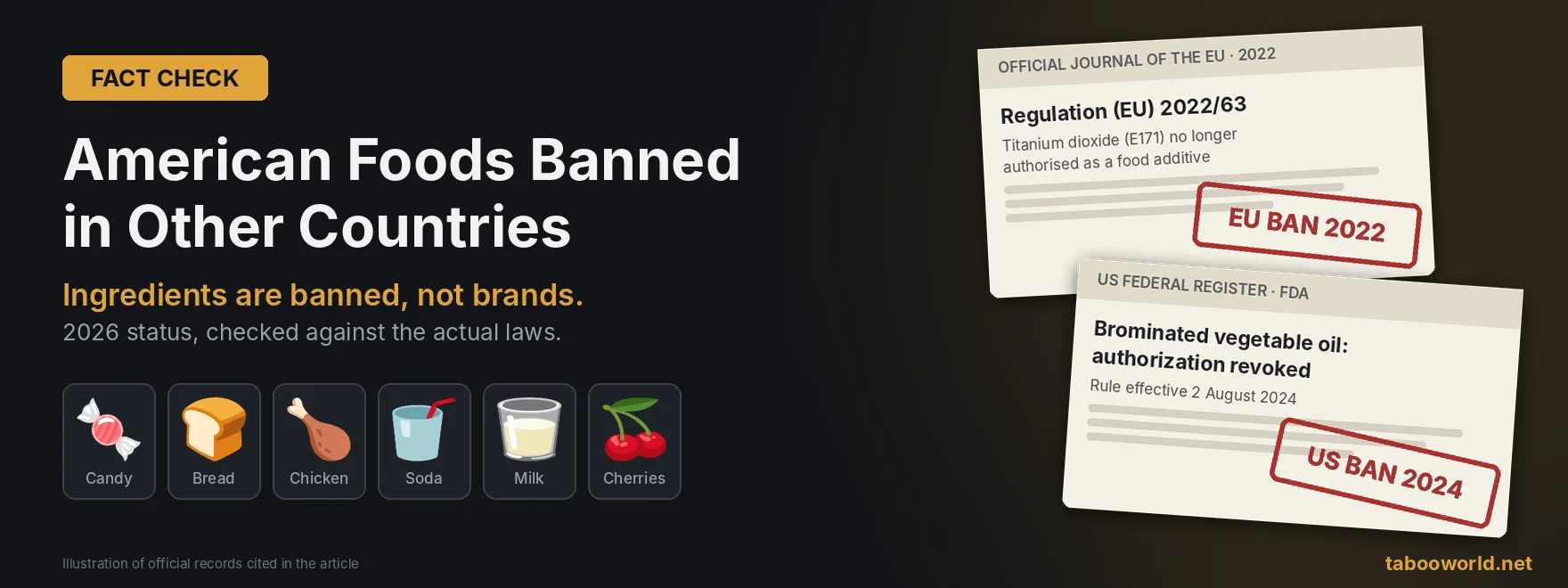
Quick answer: American foods banned in other countries are mostly a myth at the brand level. No law we checked names Skittles, Ritz or Gatorade. Countries ban ingredients instead, such as titanium dioxide, potassium bromate and ractopamine. The 2026 twist runs the other way: the US now bans Red 3 in food, while the EU still allows it in cocktail cherries.
Why we checked this: most lists on this topic copy each other and repeat claims that went out of date years ago. We traced every item to a regulator, a court record or a named news report instead. Sources include the Federal Register, FDA announcements, EUR-Lex, Ireland’s Food Safety Authority and the UK Committee on Toxicity. Status is current as of November 5, 2026.
Key facts at a glance
- The EU banned titanium dioxide (E171) in food from 7 August 2022. Great Britain still permits it.
- The EU has refused chlorine-washed poultry since 1997, and the UK kept that rule.
- The EU ban on rBST in dairy cows took effect on 1 January 2000, for animal welfare reasons.
- Europe does not ban Red 40 or Yellow 5. It requires a hyperactivity warning on the label.
- The FDA banned BVO from August 2024 and Red 3 in food from 15 January 2027.
- California bans potassium bromate, BVO, propylparaben and Red 3 from 1 January 2027.
Which American foods are banned in other countries?
Ten ingredients and farming practices explain almost every claim on these viral lists. The table below shows where each one is banned or limited, and where it stands in the US today.
| US food that may contain it | Ingredient or practice | Banned or limited in | Since | US status, Nov 2026 |
|---|---|---|---|---|
| White-coated candy, frosting, chewing gum | Titanium dioxide (E171) | European Union, including Northern Ireland | 7 Aug 2022 | Still allowed by the FDA |
| Some packaged breads, rolls and pizza dough | Potassium bromate | EU, UK, Canada, Brazil, China, India | Varies by country | Legal federally; California ban starts 1 Jan 2027 |
| Some pork and beef | Ractopamine (feed drug) | EU, China, Russia | Russia and China import rules from 2013 | Legal for US farmers |
| Chicken | Chlorine and other antimicrobial rinses | EU and UK | 1997 | Legal; used on a minority of US birds |
| Milk and dairy | rBST growth hormone given to cows | EU and Canada | Canada 1999, EU 2000 | Legal; in commercial use since 1994 |
| Beef | Growth-promoting hormones | UK and EU | UK since 1989 | Legal |
| Candy, cereal, sports drinks | Red 40, Yellow 5, Yellow 6 | Not banned; EU requires a warning label | 20 Jul 2010 | Allowed; voluntary FDA phase-out target end of 2027 |
| Some breads, buns and rolls | Azodicarbonamide (ADA) | EU and Australia | Not on the EU additive list | Legal up to 45 ppm in flour |
| Maraschino cherries, frosting | Red 3 (erythrosine, E127). See our Red 3 entry | EU allows it only in cocktail and candied cherries | Restricted since 1994 | FDA ban in food takes effect 15 Jan 2027 |
| Citrus sodas | Brominated vegetable oil (BVO). See our BVO entry | Canada, and now the US itself | Canada compliance Aug 2025 | Banned; FDA compliance date was 2 Aug 2025 |
The table shows a pattern most lists miss. Several bans target how animals are raised, not what goes into a packet. Others are labeling rules that bloggers later described as bans. We log each confirmed case in our database of food bans by country, with sources and the date we last checked it.
Is any American brand actually banned abroad?
We found no law that bans a US brand by name. Regulators list substances and practices, not products. A brand becomes “banned” in a viral post when its US recipe uses an ingredient another market forbids.
Skittles shows how fast these lists go stale. Mars told Candy Industry that it removed titanium dioxide from US Skittles at the end of 2024. The US candy still uses synthetic dyes such as Red 40 and Yellow 5, according to Food Processing. Neither fact makes Skittles illegal in Europe.
Citrus sodas made with BVO appear on almost every list, even though the FDA said in 2024 that few US beverages still contained it. Its own rule then removed the ingredient nationwide, with compliance due by 2 August 2025. That problem is already solved.
Sports drinks colored with Yellow 5 and Yellow 6 face a label rule in the EU, not a ban. Since 20 July 2010, foods with any of six “Southampton” colours must warn that they may affect activity and attention in children. A warning is not a ban, so these drinks can still be sold across Europe.
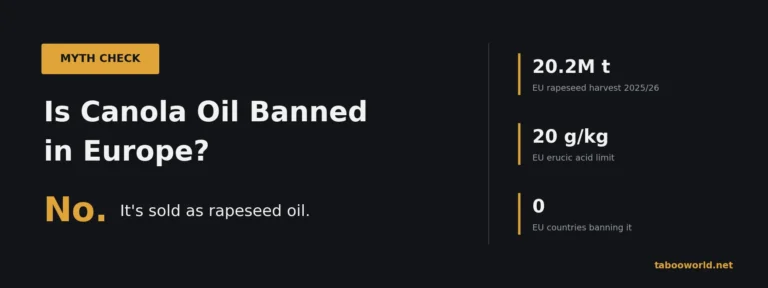
The same copy-and-paste habit fuels the claim that canola oil is banned in Europe. Our check of the actual law found that claim false.
Why are American foods banned in other countries?
The EU works from a positive list. An additive must be authorised before anyone can use it, and that authorisation can be withdrawn when the evidence changes. US regulators usually act through individual rules, as they did with BVO in 2024. That single difference explains most of this list.
In May 2021, the European Food Safety Authority (EFSA) concluded that E171 could no longer be considered safe as a food additive. It found no acute effect, so the EU gave businesses six months to reformulate.
Some bans have nothing to do with the food on your plate. When an EU scientific committee reviewed rBST in 1999, it advised against the hormone because it raised the risk of infections and fertility problems in cows. Canada banned it that year too, citing cattle health.
Trade politics plays a part as well. EFSA and two EU scientific committees cleared four poultry rinses in 2008, yet national governments overruled the Commission’s plan to approve them. The EU argues that hygiene across the whole supply chain protects consumers better than a final chemical wash.
Ractopamine split the world almost evenly. In July 2012, the Codex Alimentarius Commission adopted a residue limit of 10 parts per billion by 69 votes to 67. The EU, China and Russia kept their bans regardless.
Which American foods are banned in Europe?
Europe keeps out titanium dioxide in candy, chlorine-rinsed chicken, beef from hormone-implanted cattle, pork from ractopamine-fed pigs and milk from rBST-treated cows.
The poultry rule carries a clear price tag: a Congressional Research Service summary says the 1997 ban shut out virtually all US chicken. Some estimates put the lost US sales at $200 million to $300 million a year. US negotiators were still pushing against similar rules in Britain in 2026.
Bread is the everyday example. Potassium bromate helps dough rise higher, and the International Agency for Research on Cancer classed it as a possible human carcinogen in 1999. The FDA told FoodNavigator-USA that, under good manufacturing practice, it converts to harmless bromide during baking. The EU, the UK and Canada do not accept that argument.
Titanium dioxide was withdrawn across all EU member states and Northern Ireland. Food made after 7 August 2022 cannot contain it, though older stock could stay on shelves until its best-before date.
Does the UK follow the same rules as the EU?
Not always, and this is where many lists go wrong. Great Britain still permits titanium dioxide as a food additive, according to the UK Committee on Toxicity. Northern Ireland follows the EU ban, so the rule changes at the Irish Sea.
On meat, the UK holds the EU line. Ministers said imports of hormone-treated beef and chlorinated chicken stay illegal under the 2025 trade deal with the US. Consumer group Which? notes that the UK ban on hormone-treated beef dates back to 1989.
Pressure has not stopped. In September 2026, US Trade Representative Jamieson Greer said Britain had failed to use Brexit to open its market. The Financial Times reported that a planned UK-EU food standards deal would, in effect, keep those US products out.
What about BHA, BHT, azodicarbonamide and trans fats?
These four ingredients fill many viral lists. Only one of them fits the “banned in Europe” story.
Azodicarbonamide is a flour treatment agent that is not authorised as a food additive in the EU or Australia. The FDA still allows it in US flour at up to 45 parts per million.
BHA and BHT are different. Both are authorised food additives in the EU, listed as E320 and E321, with set limits. A fact-check published in March 2026 found no ban behind the viral claim that Wheat Thins are banned in Europe because of BHT.
Trans fats point the other way again. The FDA ruled in 2015 that partially hydrogenated oils are no longer “generally recognized as safe”, with a compliance date of 18 June 2018. Lists that blame these oils for foreign bans describe a problem the US itself has since ended, so treat any trans fat claim on these lists as years out of date.
How long has the US lagged behind Europe?
We measured the gap between each European action and the matching US decision. Where the US has not acted yet, we counted to November 2026.
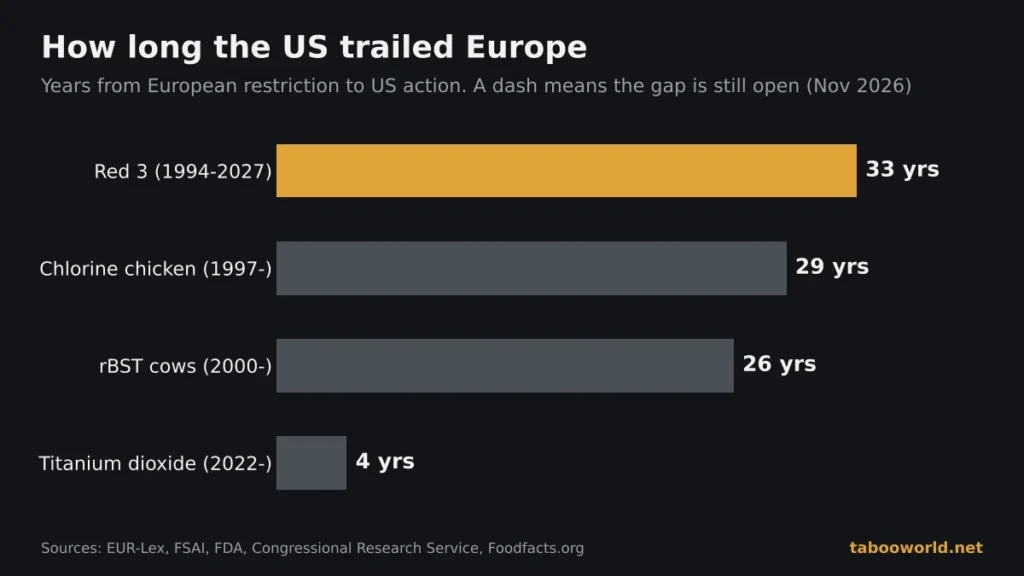
Gap in years between European restriction and US action. Open gaps counted to November 2026. Sources: EUR-Lex, FSAI, FDA, Congressional Research Service, Foodfacts.org. Chart by TabooWorld.
Red 3 shows the gap can close fast once politics shifts. It took 33 years, yet the final US rule is stricter than Europe’s cherry exception. The January 2027 deadline now sets the pace for US candy and cherry makers.
Is the US now banning these ingredients too?
Yes, but slowly and mostly through deadlines that have not arrived. At the federal level, the FDA has taken four formal steps on food additives since 2024.
- BVO: revoked from 2 August 2024, with enforcement from 2 August 2025.
- Red 3: revoked for food from 15 January 2027 and for ingested drugs from 18 January 2028.
- Orange B: revoked from 8 September 2026. It was used on sausage casings.
- Citrus Red No. 2: proposed for revocation on 22 July 2026 and still pending in late October.
The six most common dyes are a different story. In April 2025, HHS and the FDA announced a plan to phase out Red 40, Yellow 5, Yellow 6, Blue 1, Blue 2 and Green 3. Companies sign up voluntarily, so this is a pledge rather than a ban. Without any formal announcement, the agency’s tracker later moved the target from the end of 2026 to the end of 2027. According to the Center for Science in the Public Interest, titanium dioxide is not covered at all.
States are moving faster. California’s AB 418 bans potassium bromate, BVO, propylparaben and Red 3 in all food from 1 January 2027. West Virginia passed a broader dye ban for all food from 2028. On 23 December 2025, a federal judge paused that part of the law, though its school-meal ban still applies. A federal court also blocked Texas SB 25 in February 2026, which would require warnings on foods with any of 44 listed additives. The Texas attorney general has appealed.
Public opinion leans one way. In a March 2026 survey, Consumer Reports found that 66 percent of Americans think companies should be required to phase out synthetic dyes.
When did each ban take effect?
This timeline lists the dates that matter most for US shoppers, oldest first.
- 1989: The UK bans hormone-treated beef.
- 1994: The EU limits Red 3 to cocktail and candied cherries.
- 1997: The EU stops accepting poultry treated with chlorine and similar rinses.
- 2000: The EU ban on rBST in dairy cows takes effect, one year after Canada’s.
- 2010: EU warning labels for six synthetic colours become mandatory on 20 July.
- 2012: Codex adopts a ractopamine limit by 69 votes to 67.
- 2018: The US compliance date for removing partially hydrogenated oils arrives on 18 June.
- 2022: The EU bans titanium dioxide in food from 7 August.
- 2025: The FDA starts enforcing its BVO ban on 2 August.
- 2026: The FDA revokes Orange B, effective 8 September.
- 2027: California’s AB 418 and the federal Red 3 food ban both start in January.
How can you spot these ingredients on a US label?
Most of these ingredients appear under plain names, so a quick scan of the ingredient list works. On bread and pizza dough, look for “bromated flour” or “potassium bromate”. Titanium dioxide is listed by name.
Synthetic dyes show up as a colour plus a number, such as Red 40, sometimes followed by “Lake”. Be careful with “no artificial colors”. Under FDA guidance from February 2026, that claim can still appear on foods colored with natural sources.
Farm practices are harder to spot, because ractopamine and rBST are given to animals and never appear in an ingredient list. Producer claims on the pack, or the brand’s own website, are the only clue.
Does a ban abroad mean a US food is unsafe?
Not automatically. Regulators weigh the same studies differently, and some bans protect animals or domestic farmers rather than consumers. The UK Food Standards Agency, for example, reviewed EFSA’s titanium dioxide opinion and chose not to ban it in 2022.
US agencies still describe chlorine rinses and approved feed additives as safe at permitted levels, while critics argue that Europe’s precautionary approach is the better default for long-term exposure. Both sides cite real evidence. The useful question is what each rule actually covers.
This article is general information, not medical or dietary advice. Talk to a doctor or registered dietitian about your own diet.
Key takeaways
- No country bans an American brand by name; laws target ingredients and farming methods.
- Europe’s strictest rules cover titanium dioxide, chlorine-washed poultry, hormone beef, ractopamine and rBST.
- Red 40 and Yellow 5 are legal in the EU but carry a warning label for children.
- The UK and the EU now differ on titanium dioxide, so “banned in the UK” claims need checking.
- US federal action is real but slow, while California sets the first hard deadline on 1 January 2027.
Food bans also travel in the opposite direction. Kinder Surprise eggs are still kept out of US stores, despite being sold across Europe.
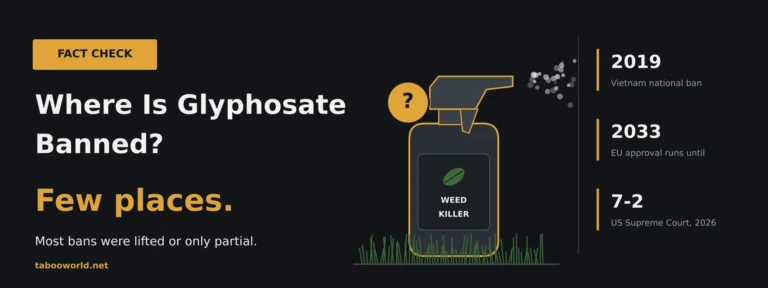
Farm chemicals show a similar split between regulators. Our report on where glyphosate is banned maps that story country by country.
Update log: November 5, 2026. First published. Federal, EU, UK, California, West Virginia and Texas rules checked on this date. We update this page when a listed rule changes.
Frequently asked questions
What American foods are banned in other countries?
No country bans a US brand by name. Other markets ban ingredients or farming practices found in some US foods. The best-known examples are titanium dioxide in candy, potassium bromate in bread, ractopamine in pork, chlorine-washed chicken and milk from cows given rBST.
Why are American foods banned in other countries?
Reasons differ by ingredient. The EU withdrew titanium dioxide after EFSA said it could no longer be considered safe. Its rBST ban rests on cow welfare, and its poultry rule reflects a preference for hygiene over chemical rinses. Trade politics shapes some decisions too.
Is Red 40 banned in Europe?
No. The EU allows Red 40, listed as E129, but foods that contain it must carry a warning. Since 20 July 2010, the label has had to say the colour may have an adverse effect on activity and attention in children.
Are Skittles banned in Europe?
No law bans Skittles. The EU banned titanium dioxide in 2022, an additive the US recipe once used. Mars says it removed titanium dioxide from US Skittles at the end of 2024. US Skittles still use synthetic dyes such as Red 40.
Is chlorinated chicken banned in the UK?
Yes. The UK kept the EU rule that blocks poultry washed with chlorine and similar rinses. UK ministers said the 2025 trade deal with the US did not change this. Hormone-treated beef also remains illegal in the UK.
Is the US banning food dyes in 2026?
Only partly. The FDA revoked Red 3 for food from 15 January 2027 and Orange B from September 2026. Six common dyes, including Red 40, face a voluntary phase-out with a target of the end of 2027, not a legal ban.
Sources
- FDA: FDA Revokes Regulation Allowing the Use of BVO in Food (2024)
- Federal Register: Revocation of Authorization for Use of BVO in Food
- FDA: Further steps to remove outdated color additive authorizations (July 2026)
- Food Safety Authority of Ireland: Titanium dioxide no longer authorised (2022)
- UK Committee on Toxicity: Safety of titanium dioxide (E171)
- Food Ingredients First: UK rejects titanium dioxide ban (2022)
- EUR-Lex: Council Decision 1999/879/EC on bovine somatotrophin
- FSAI: Labelling of food additives and colour warnings
- Foodfacts.org: Red 3 and cocktail cherries in the EU and UK
- Congressional Research Service: US-EU poultry dispute
- Food Safety News: Codex ractopamine vote
- Bakery and Snacks: Potassium bromate, Europe vs America
- Which?: US-UK trade deal and food standards
- Irish Times / Financial Times: US says Britain not taking advantage of Brexit (Sept 2026)
- CSPI: Synthetic dyes corporate commitment tracker
- Consumer Reports: One year later, are synthetic dyes still in our food?
- California Legislature: AB 418, California Food Safety Act
- Food Safety News: Judge stalls West Virginia food dye ban (Jan 2026)
- Haynes Boone: Texas SB 25 injunction and appeal (March 2026)
- Federal Register: Final Determination Regarding Partially Hydrogenated Oils (2015)
- eCFR: 21 CFR 172.806, Azodicarbonamide
- Fact Crescendo: Wheat Thins are not banned over BHT (March 2026)
- Snack Food & Wholesale Bakery: Mars strips titanium dioxide from US Skittles
- Food Processing: Skittles still use synthetic dyes