





Quick answer: Are vapes getting banned? Not everywhere, and not all at once. There is no nationwide ban on vapes in the United States, and the FDA has actually authorized more products in 2026, including the first fruit flavors. But vapes are being squeezed out state by state in three ways: flavor bans (6 states […]
Quick answer: Are vapes getting banned?
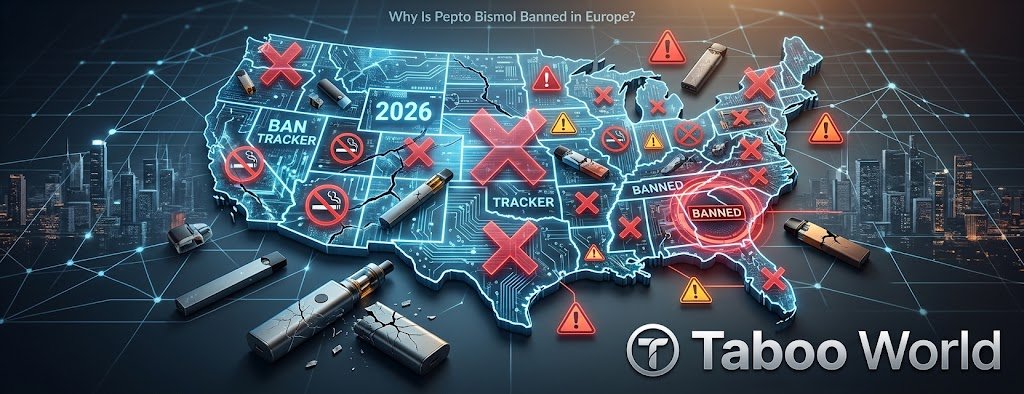
Not everywhere, and not all at once. There is no nationwide ban on vapes in the United States, and the FDA has actually authorized more products in 2026, including the first fruit flavors. But vapes are being squeezed out state by state in three ways: flavor bans (6 states plus Washington, D.C.), “directory” laws that only allow listed products (17 states), and disposable bans (Hawaii from January 1, 2027). In practice, most cheap flavored disposables sold today are already illegal under federal rules, and more states are now seizing them.
Watch: Are vapes getting banned? The 60-second version.
Key Takeaways
- No federal ban: Adults 21+ can still legally buy FDA-authorized vapes in all 50 states.
- Only 45 products are fully legal nationwide: After a May 2026 decision, the FDA’s authorized list grew to 45 e-cigarettes.
- The real “ban” is on unauthorized vapes: Most flavored disposables have no FDA authorization, so they are on the market illegally.
- States are moving faster than Washington: 17 states have directory laws, 6 states plus D.C. ban flavored e-cigarettes, and Hawaii bans disposables in 2027.
- Next dates to watch: Pennsylvania seizures (after Oct. 19, 2026), Hawaii’s disposable ban (Jan. 1, 2027), and the UK’s new rules (from Oct. 29, 2026).
Will Vapes Be Banned in the USA?
A full federal ban is very unlikely right now. The direction of federal policy in 2026 has been the opposite: more authorizations, not fewer.
On May 5, 2026, the FDA authorized four Glas pods (Classic Menthol, Fresh Menthol, Gold, which is mango, and Sapphire, which is blueberry). It was the first time the agency cleared a vape flavor other than tobacco or menthol. That brought the number of e-cigarettes that can be lawfully sold in the U.S. to 45, according to HealthDay’s report on the decision. Users must verify their age with a government ID and pair the device to their phone over Bluetooth before it works.
So why does everyone say vapes are being banned? Because the federal system already blocks most products. Under the previous administration, the FDA denied more than a million applications for fruit- and candy-flavored products. In April 2025, the U.S. Supreme Court unanimously sided with the FDA in FDA v. Wages and White Lion, upholding those denials. The cheap disposables that teens use are technically illegal, but they remain widely available because many are imported from China.
The result is a two-tier market:
- Legal tier: 45 FDA-authorized products, mostly tobacco and menthol, from large companies.
- Gray/illegal tier: Thousands of flavored disposables with no authorization. This is the tier states are now banning and seizing.
The 3 Ways Vapes Are Being Banned in 2026
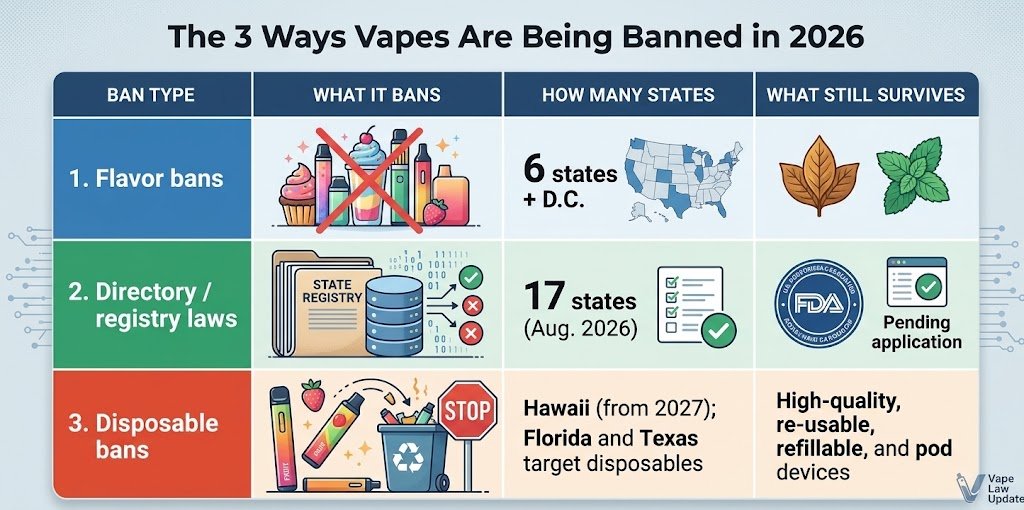
Most articles list states. That is useful, but it hides the bigger picture. Every U.S. vape restriction today falls into one of three types, and each one affects buyers differently.
| Ban type | What it bans | How many states | What still survives |
|---|---|---|---|
| 1. Flavor bans | Fruit, candy, dessert and (in some states) menthol vapes | 6 states + D.C. | Tobacco flavor (and sometimes menthol) |
| 2. Directory / registry laws | Any vape not listed on a state-approved list | 17 states (Aug. 2026) | FDA-authorized products, plus some with pending applications |
| 3. Disposable bans | Single-use, throwaway vapes | Hawaii (from 2027); Florida and Texas target disposables | Refillable and pod devices |
1. Flavor bans
According to Truth Initiative’s March 2026 policy database, seven states have statewide flavored tobacco laws. Six of them cover e-cigarettes:
- California: Bans the sale of nearly all flavored tobacco products, including flavored vapes. Since January 1, 2026, it has also required products to appear on the Attorney General’s Unflavored Tobacco List, which works like a directory and also blocks “cooling” products that imitate menthol.
- Massachusetts: Bans all flavored tobacco products, with an exception only for licensed smoking bars.
- New Jersey: Bans all flavored vaping products, including menthol. It was the first state to make this permanent, in 2020.
- New York: Bans flavored e-cigarettes unless the FDA has authorized them.
- Rhode Island: Bans flavored e-cigarettes, though menthol was allowed back in January 2025.
- Utah: Bans flavored e-cigarettes except menthol, in all retailers.
The seventh state, Maine, only restricts flavored cigars at the state level. Washington, D.C. also bans flavored products and blocks vape sales within a quarter mile of middle and high schools. Beyond states, hundreds of cities and counties have their own rules. Truth Initiative counts 435 local and state jurisdictions with flavor restrictions, covering about 27% of the U.S. population, and 82 jurisdictions that ban the sale of all e-cigarettes, mostly in California and Massachusetts.
2. Directory (registry) laws: the ban most people miss
This is the fastest-growing type of vape ban, and it is the reason many shops are emptying their shelves. A directory law says retailers can only sell vapes that appear on a state list. To get listed, a product usually needs FDA authorization or a pending FDA application.
By August 2026, 17 states had enacted directory laws. States with laws in place include Alabama, Arkansas, Florida, Iowa, Kentucky, Louisiana, Mississippi, North Carolina, Oklahoma, Pennsylvania, Tennessee, Utah, Virginia and Wisconsin. In Arkansas and Louisiana, the rules go further and also make it illegal to possess an unlisted product, according to Vaping360’s coverage of the Arkansas law.
Here is why this matters: a directory law does not need the word “ban” to wipe out most flavored disposables. If a product was never authorized, it cannot get listed, and if it is not listed, it cannot be sold.
3. Disposable bans
Hawaii has the broadest disposable ban, but it is not alone. Florida’s directory focuses on disposable “nicotine dispensing devices,” leaving refillable e-liquids less affected, and Texas passed a 2025 law aimed at China-made disposables. Hawaii goes furthest. Its new laws, covered below, ban the sale of disposable e-cigarettes from January 1, 2027. Environmental concerns are part of the reason: discarded vapes add to litter, and their lithium batteries can start fires or leak metals.
Hawaii’s “99.9%” Vape Ban: What Happens on January 1, 2027
Hawaii passed the toughest vape laws in the country in 2026. Governor Josh Green signed two bills in July and said they would remove “99.9%” of e-cigarette products from sale, as Aloha State Daily reported.
- SB 2175: Bans the sale and distribution of all disposable e-cigarettes from January 1, 2027. Fines are $100 per day, per product.
- HB 1573: Only FDA-authorized vapes and e-liquids can be sold. Manufacturers had to start certifying products on October 1, 2026, and the state publishes its approved directory on January 1, 2027.
- Penalties: Retailers face $500 per product for a first violation, rising to $2,000 by the fourth. Manufacturers can be fined up to $10,000 per product.
State-by-State: Where Vapes Are Being Restricted Right Now
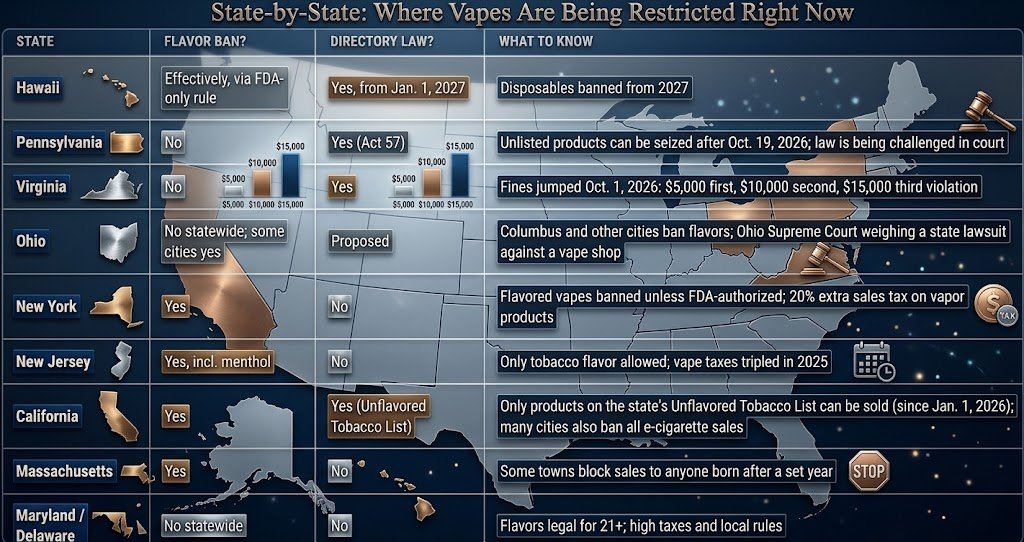
These are the states readers ask about most. The table focuses on what a buyer can actually purchase today.
| State | Flavor ban? | Directory law? | What to know |
|---|---|---|---|
| Hawaii | Effectively, via FDA-only rule | Yes, from Jan. 1, 2027 | Disposables banned from 2027 |
| Pennsylvania | No | Yes (Act 57) | Unlisted products can be seized after Oct. 19, 2026; law is being challenged in court |
| Virginia | No | Yes | Fines jumped Oct. 1, 2026: $5,000 first, $10,000 second, $15,000 third violation |
| Ohio | No statewide; some cities yes | Proposed | Columbus and other cities ban flavors; Ohio Supreme Court weighing a state lawsuit against a vape shop |
| New York | Yes | No | Flavored vapes banned unless FDA-authorized; 20% extra sales tax on vapor products |
| New Jersey | Yes, incl. menthol | No | Only tobacco flavor allowed; vape taxes tripled in 2025 |
| California | Yes | Yes (Unflavored Tobacco List) | Only products on the state’s Unflavored Tobacco List can be sold (since Jan. 1, 2026); many cities also ban all e-cigarette sales |
| Massachusetts | Yes | No | Some towns block sales to anyone born after a set year |
| Maryland / Delaware | No statewide | No | Flavors legal for 21+; high taxes and local rules |
Sources: FOX 5’s October 2026 state law roundup, Truth Initiative, and LegalClarity’s Ohio explainer.
Are they banning vapes in Pennsylvania?
Not by flavor, but by list. Governor Josh Shapiro signed Act 57 on December 22, 2025, creating a directory of legal vape products. Products that are not on it can be seized after October 19, 2026. Adults 21+ can still buy fruit and menthol flavors, but only if the product has FDA authorization or a pending application. A group of retailers has asked a federal judge to block the law.
Is Virginia banning vapes?
Virginia has no flavor ban, but it bans the sale of any vape that is not on the Attorney General’s directory. Since October 1, 2026, penalties start at $5,000 for a first violation. Online sellers that ship into directory states are also expected to check their products against each state’s list, so many flavored disposables are now hard to buy legally online in Virginia too.
Are vapes banned in Ohio?
No. Ohio has no statewide flavor ban, and adults can buy vapes. But cities including Columbus have their own flavor bans after winning a court fight over local control. The state is also suing at least one shop for selling unauthorized vapes, and a registry bill has been proposed.
Why Are Vapes Being Banned?
Three reasons drive almost every new law:
- Youth use of flavored disposables. Teen vaping has fallen, but it has not gone away. In the 2025 National Youth Tobacco Survey, 5.2% of middle and high school students said they had vaped in the past 30 days. About two-thirds of teen vapers now use disposables, and around 90% use flavored products, according to a 2026 analysis of the survey data.
- Illegal imports. Most flavored disposables never received FDA authorization. States use directory laws to seize them because federal enforcement has not kept up.
- Waste and fire risk. Disposables are thrown away with lithium batteries inside, which is why Hawaii, the UK and others target them specifically.
What Vapes Aren’t Getting Banned?
If you are an adult who vapes, these products are the safest bet to stay legal:
- FDA-authorized products. The 45 authorized e-cigarettes are legal in every state that does not ban them by flavor. They are mostly tobacco and menthol pods from large brands, plus the four Glas pods authorized in 2026.
- Tobacco-flavored products. Even the strictest flavor bans, like New Jersey’s, allow tobacco flavor.
- Refillable and pod devices. Disposable bans do not touch them, though the liquid inside still has to be legal in your state.
The products most at risk are unauthorized, flavored, disposable vapes. Those are the ones being banned, seized and taxed.
Key Dates: What Changes Next
| Date | What happens |
|---|---|
| Oct. 1, 2026 | Virginia’s higher directory fines begin; Hawaii manufacturers start certifying products |
| Oct. 19, 2026 | Pennsylvania can seize unlisted vapes |
| Oct. 29, 2026 | UK’s Tobacco and Vapes Act: new age-of-sale rules, fines and a vending machine ban |
| Jan. 1, 2027 | Hawaii’s disposable ban and FDA-only directory take effect |
| 2027 sessions | More states expected to debate flavor bans and registries; around 15 considered flavor limits in 2026 |
Are Vapes Banned Outside the U.S.?
Yes, and some countries go much further than any U.S. state. More than 30 countries ban vape sales outright, according to WHO figures cited by news outlets. A few examples:
- United Kingdom: The UK banned single-use vapes in 2025. You can read how that rule works in our UK disposable vape ban entry. Its new Tobacco and Vapes Act 2026 adds more restrictions from October 29, 2026.
- Singapore: One of the strictest places in the world for vaping. See the details in our Singapore e-cigarettes and vapes listing.
- Thailand: A popular tourist destination where travelers are often caught out. Our guide to Thailand’s vape ban explains what visitors should know.
- Others: India, Brazil, Taiwan and Myanmar are among the countries that have banned e-cigarettes.
Vapes are one of many everyday items with very different rules across borders. Browse more in our Banned Around the World tracker.
Frequently Asked Questions
Will vapes be banned in the USA?
A full nationwide ban is not expected. The FDA authorized more products in 2026, bringing the total to 45. Instead, states are banning flavors, unlisted products and disposables one by one.
What vapes aren’t getting banned?
FDA-authorized vapes, tobacco-flavored products and refillable devices are the least likely to be banned. Unauthorized flavored disposables are the main target of new laws.
Does PA still sell flavored vapes?
Yes, for adults 21+, but only products on Pennsylvania’s new directory. Unlisted products can be seized after October 19, 2026.
Can I still order vapes online in Virginia?
Only products listed on Virginia’s directory can be legally sold into the state. Sellers that ship unlisted products risk fines starting at $5,000, so expect fewer flavored options online.
Can lungs heal after 7 years of vaping?
Often, partly. According to Baptist Health, lung function can start improving within two to three weeks of quitting, but coughing and breathing problems may last a year or longer. How quitting affects long-term risks like cancer is not yet known. Talk to a doctor about your own lungs.
Is vaping 95% safer than smoking?
That number is not reliable. It came from a 2014 expert estimate that Public Health England repeated in 2015. The Lancet called its basis “extraordinarily flimsy,” and the WHO said in 2016 that no specific safety figure could be given scientific credibility, as The Conversation explains. Vaping exposes users to fewer toxins than smoking, but it is not harmless.
Is 1 puff of a vape a day bad?
There is no proven safe level of nicotine use, especially for teens and young adults, whose brains are still developing. Even small daily amounts can build dependence over time.
What is vaper’s tongue?
It is a common term for a temporary loss of the ability to taste your vape’s flavor. Users often link it to dehydration or getting used to one flavor. It usually passes, but see a doctor if your sense of taste changes for a long time.
Final Verdict: Banned, Restricted, or Just Shrinking?
Vapes are not being banned across the United States, but the market is shrinking fast. The FDA keeps a short list of legal products, and states are turning that list into the law of the land: 17 with directory laws, 6 plus D.C. with flavor bans, and Hawaii with the first disposable ban. If you vape, stick to authorized products and check your state’s directory. If you sell vapes, the age of the cheap flavored disposable is ending, one state at a time.
This article is for general information only and is not legal or medical advice. Laws change often, so check your state’s official sources. If you want help quitting, talk to a healthcare provider.