

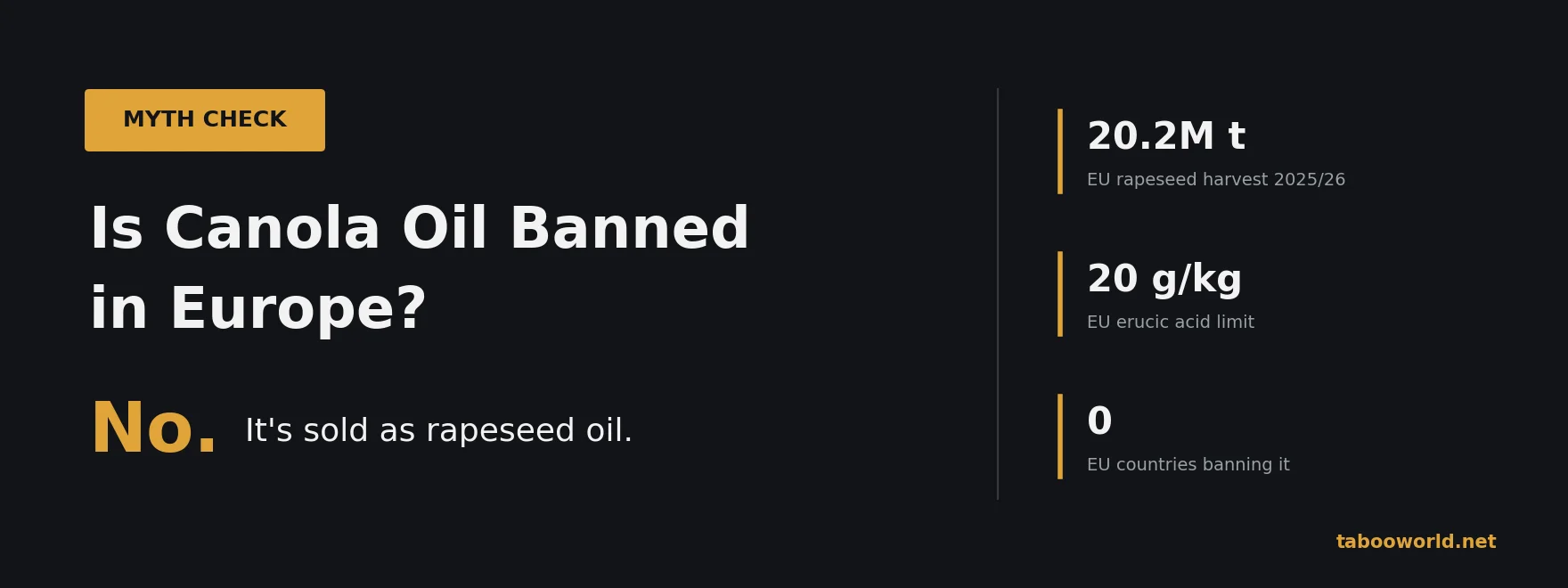
Quick answer: Canola oil is not banned in Europe. It is sold across the EU as rapeseed oil, and rapeseed is the EU’s biggest oilseed crop. EU law only caps erucic acid in vegetable oils at 20 g/kg (2%), and genetically modified rapeseed may be imported for food but not grown on EU farms. The […]
Quick answer: Canola oil is not banned in Europe. It is sold across the EU as rapeseed oil, and rapeseed is the EU’s biggest oilseed crop. EU law only caps erucic acid in vegetable oils at 20 g/kg (2%), and genetically modified rapeseed may be imported for food but not grown on EU farms. The “ban” is an online myth.
Why we checked this: “Canola oil is banned in Europe” keeps turning up in viral lists of American foods Europe supposedly refuses. Instead of repeating it, we went to the source: EU food law on EUR-Lex, the European Commission’s own crop data and the EU’s GMO approvals. Here is what those documents actually say.
Key facts at a glance
- Legal status in the EU: Legal, sold as rapeseed oil
- Erucic acid limit: 20 g/kg in most vegetable oils (Regulation (EU) 2023/915)
- Infant formula limit: 0.4% of total fat
- GM canola: Some varieties approved for import; cultivation not permitted
- EU rapeseed harvest 2025/26: About 20 million tonnes, more than double sunflower
- Same oil, different name: Canola (North America) = rapeseed oil (Europe)
Is canola oil actually banned in Europe?
No. We could not find a single EU regulation, or a UK one, that stops canola oil from being sold as food. What you won’t find in a European supermarket is the word “canola”. The oil itself sits on almost every shelf, just under a local label: rapeseed oil (Rapsöl in Germany, huile de colza in France, olej rzepakowy in Poland). In the UK, cold-pressed rapeseed oil is even marketed as a premium, home-grown alternative to olive oil.
What Europe does have are rules on canola-type oils, and those rules are where the myth comes from. There are two: a strict limit on a natural fatty acid called erucic acid, and tight controls on genetically modified (GM) crops. Neither one is a ban. The same pattern shows up in many “banned in Europe” claims about American products, from food additives to medicines.
What is the difference between canola oil and rapeseed oil?
Think of canola as rapeseed with a makeover. Older rapeseed (Brassica napus) gave an oil packed with erucic acid, so it went into machines, not kitchens. Canadian breeders changed that in the 1970s, selecting plants that were low in both erucic acid and glucosinolates, the compounds that made rapeseed meal bitter for livestock. They then needed a name that left the old reputation behind, and settled on “canola”, a blend of “Canada” and “oil, low acid”.
Europe grows the same kind of low-erucic plant, often called “double-low” or “00” rapeseed. So when a European buys rapeseed oil for cooking, they are buying the same food-grade oil that North Americans call canola. The only real exception is high-erucic rapeseed (HEAR), a separate crop still grown under contract for industrial uses such as lubricants and plastics. It is not sold as cooking oil.
| Feature | Industrial (high-erucic) rapeseed oil | Canola / food-grade rapeseed oil |
|---|---|---|
| Erucic acid | High | Below 2% (legal limit) |
| Main use | Lubricants, plastics, industry | Cooking, margarine, packaged foods |
| Name used in Europe | High-erucic rapeseed (HEAR) | Rapeseed oil |
| Name used in North America | Rapeseed | Canola oil |
How much canola does Europe actually grow and use?
If Europe had banned canola, it would have banned its own most important oilseed. According to European Commission market data, the EU’s 2025/26 rapeseed harvest was about 20.2 million tonnes, compared with roughly 8.4 million tonnes of sunflower seed and 2.8 million tonnes of soybeans.
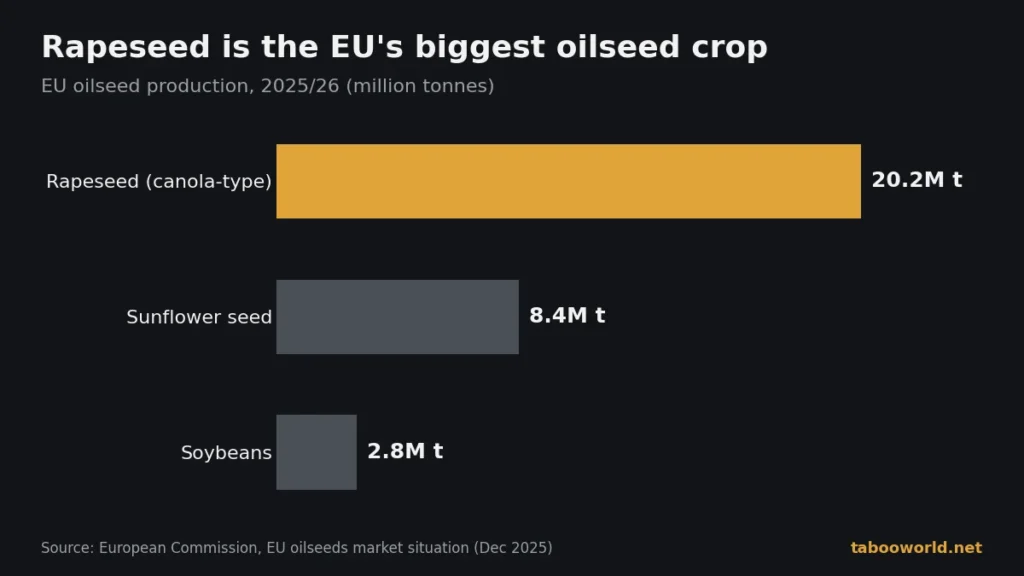
| EU oilseed crop (2025/26) | Production |
|---|---|
| Rapeseed (canola-type) | ~20.2 million tonnes |
| Sunflower seed | ~8.4 million tonnes |
| Soybeans | ~2.8 million tonnes |
Source: European Commission, EU oilseeds market situation, December 2025 report.
France is the EU’s largest rapeseed grower, followed by Germany, Poland and Romania. Even that is not enough for European demand: the EU also imports millions of tonnes of rapeseed each year, mainly from Ukraine, with Canada and Australia among other suppliers. In other words, Europe buys Canadian canola. It does not ban it.
Rapeseed oil is the everyday cooking oil in much of northern and central Europe, while olive oil dominates in the south (Spain, Italy, Greece) and sunflower oil is common in the east.
What does EU law limit in canola and rapeseed oil?
The EU treats erucic acid as a food contaminant. The European Food Safety Authority (EFSA) and Germany’s Federal Institute for Risk Assessment (BfR) note that a high intake over a long period can cause a heart-muscle condition called myocardial lipidosis, seen in animal studies. Because of that, the EU sets a maximum level instead of banning the oil.
The limit has been tightened over time:
| Year | EU rule | What changed |
|---|---|---|
| 1976 | Council Directive 76/621/EEC | First EU-wide erucic acid cap (5%) for edible oils and margarine |
| 2014 | Regulation (EU) No 696/2014 | Limit moved into the main contaminants law at 50 g/kg |
| 2016 | Delegated Regulation (EU) 2016/127 | Infant and follow-on formula capped at 0.4% erucic acid of total fat |
| 2019 | Regulation (EU) 2019/1870 | Cut to 20 g/kg for most vegetable oils, matching the Codex standard for low-erucic rapeseed oil; higher limit kept for camelina, mustard and borage oils; new limit added for mustard |
| 2023 | Regulation (EU) 2023/915 | Replaced the 2006 contaminants law; the 20 g/kg limit stays in force |
Put simply, the EU tests the oil, not the plant’s name. Rapeseed or canola oil under the 2% line is ordinary food; a batch over it is blocked from the food market. That rule applies to every vegetable oil, not just canola, and food-grade canola is bred to stay well under it.
Is GM canola allowed in the EU?
Here the myth has a grain of truth behind it. On North American farms, canola is overwhelmingly a GM crop, usually engineered to survive herbicide spraying. The EU handles GM crops through a case-by-case approval system run by the European Commission, with safety assessments from EFSA.
Several GM oilseed rape varieties, including MON 88302 and MON 94100, are authorised for import as food and feed. Those approvals expressly exclude cultivation, so European farmers do not grow GM rapeseed. Food made with authorised GM ingredients must also carry a GM label, which is one reason many European brands prefer non-GM oil.
So GM canola is restricted in how it can enter and be used in Europe, but it is not banned outright, and conventional canola-quality rapeseed is grown on millions of hectares across the EU.
How is canola oil made, and does the EU allow hexane?
Most supermarket canola and rapeseed oil is refined. Seeds are pressed, and the remaining oil is usually extracted with the solvent hexane, then refined, bleached and deodorised to give a neutral taste and a high smoke point. Cold-pressed rapeseed oil skips the solvent and heavy refining; it is golden, nutty in flavour and popular in the UK and Germany.
Online posts often claim Europe bans hexane-extracted oil. It does not. The EU’s extraction solvents directive (2009/32/EC) permits hexane for producing fats and oils, with a maximum residue of 1 mg per kg in the finished oil. Refined rapeseed oil made this way is sold legally across the EU.
Is canola oil safe to eat?
Food-grade canola oil is approved as safe by regulators in the EU, the US, Canada and the UK. In the US, the Food and Drug Administration (FDA) lists low-erucic rapeseed oil as “generally recognized as safe” (GRAS) under 21 CFR 184.1555.
Its fat profile is the main reason it is widely recommended. According to the Canola Council of Canada (an industry body), canola oil contains about 7% saturated fat, 62% monounsaturated fat, 19% omega-6 and 9% plant-based omega-3. In 2006 the FDA also allowed a qualified health claim stating that limited, not conclusive evidence suggests about 1.5 tablespoons a day, used in place of saturated fat, may reduce heart disease risk.
Critics of “seed oils” raise three concerns: the omega-6 content, the heavy processing of refined oils, and GM crops grown with herbicides. These are debated topics, but none of them has led any European government to restrict canola oil. If you want the least processed option, choose cold-pressed rapeseed oil. This article is general information, not medical advice; talk to a doctor or dietitian about your own diet.
Why do people think canola oil is banned in Europe?
- Name confusion. Americans don’t see “canola” on European labels and assume it is missing.
- The old rapeseed reputation. High-erucic industrial rapeseed oil really was unfit for food, and older warnings get mixed up with modern canola.
- GMO headlines. Stories about Europe refusing GM crop cultivation are often retold as “Europe bans canola.”
- The seed-oil trend. Wellness influencers and short videos often list canola among “foods banned in Europe” without citing a law. Our look at why Pepto Bismol is said to be banned in Europe shows the same pattern: one real restriction becomes a viral “ban.”
- Lists that copy each other. Many “American foods banned in Europe” lists repeat the same items without sources, so a mistake spreads quickly.
Canola oil rules: EU vs US vs Canada vs UK
| Region | Legal status | Erucic acid rule | GM canola |
|---|---|---|---|
| European Union | Legal (sold as rapeseed oil) | Max 20 g/kg (Reg. 2023/915) | Some varieties authorised for import; not grown |
| United States | Legal; FDA lists low-erucic rapeseed oil as GRAS | Max 2% (21 CFR 184.1555) | Widely grown |
| Canada | Legal; canola was developed here | Under 2% by definition of “canola” | Widely grown |
| United Kingdom | Legal (sold as rapeseed oil) | 20 g/kg under retained EU law | Not grown commercially |
The standard is almost the same on both sides of the Atlantic: about 2% erucic acid. The real difference is GM cultivation, not whether the oil is allowed.
Canola vs olive vs sunflower oil in Europe
| Oil | EU status | Where it’s most used | Typical use |
|---|---|---|---|
| Rapeseed (canola) | Legal, 20 g/kg erucic acid limit | Germany, France, Poland, UK, Nordics | Frying, baking, dressings, margarine |
| Olive | Legal, strict grading rules (extra virgin, virgin, etc.) | Spain, Italy, Greece, Portugal | Dressings, cooking, finishing |
| Sunflower | Legal, same 20 g/kg limit | Eastern and central Europe | Frying, processed foods |
Key takeaways
- Canola oil is legal in the EU and UK; Europeans buy it as rapeseed oil.
- Rapeseed is the EU’s largest oilseed crop, and the EU still imports extra from Ukraine, Canada and Australia.
- EU law caps erucic acid at 20 g/kg in vegetable oils, the same 2% level used in the US.
- GM canola can be imported for food under specific EU approvals but is not grown in the EU.
- Hexane-extracted refined oil is legal in the EU; cold-pressed rapeseed oil is the less processed choice.
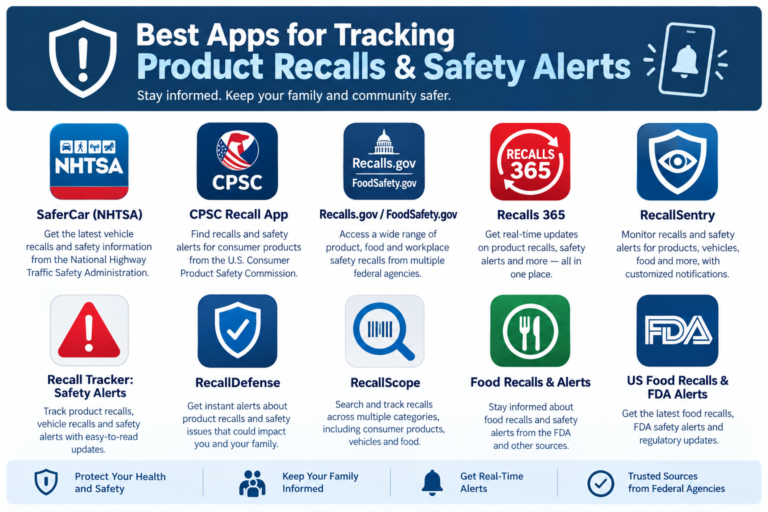
Food safety rules change, and recalls happen fast. If you want alerts on your phone, see our guide to the best apps for tracking product recalls and safety alerts. To see what countries really prohibit, browse the TabooWorld Banned Around the World database, where every entry lists its legal status and sources.
Frequently asked questions
Is canola oil illegal in Europe?
No. Canola oil is legal across the European Union and is sold under the name rapeseed oil. EU law only limits its erucic acid content to 20 g/kg, a standard that food-grade canola already meets. No EU country has banned it as a food.
What is canola oil called in Europe?
In Europe it is usually labelled rapeseed oil. In Germany it is called Rapsöl, in France huile de colza, and in the UK simply rapeseed oil. The oil comes from the same low-erucic rapeseed varieties that North Americans call canola.
Does Europe import canola from Canada?
Yes. The EU grows about 20 million tonnes of rapeseed a year but still imports several million tonnes more. Ukraine is the main supplier, and Canada and Australia also ship rapeseed and canola to Europe, which would be impossible if it were banned.
Why does the EU limit erucic acid?
EFSA links long-term high intake of erucic acid to myocardial lipidosis, a build-up of fat in heart muscle observed in animal studies. To keep intake low, the EU sets a maximum of 20 g/kg in most vegetable oils under Regulation (EU) 2023/915.
Is GM canola banned in the EU?
Not fully. Several GM oilseed rape varieties are authorised for import as food and feed, and products containing them must be labelled. However, those approvals do not allow cultivation, so GM rapeseed is not grown on European farms.
Is canola oil banned in the UK?
No. Rapeseed oil is widely sold in the UK, including cold-pressed versions from British farms. The UK applies the same 20 g/kg erucic acid limit it kept from EU law after Brexit.
Sources
- Commission Regulation (EU) 2023/915 on maximum levels for contaminants in food – EUR-Lex
- Commission Regulation (EU) 2019/1870 on erucic acid – EUR-Lex
- Directive 2009/32/EC on extraction solvents – EUR-Lex
- European Commission – EU oilseeds market situation (PDF)
- BfR – Erucic acid health assessment (PDF)
- AGRINFO – EU authorisation of GM oilseed rape MON 94100 (import only)
- AGRINFO – Renewed authorisation of GM oilseed rape MON 88302
- US eCFR – 21 CFR 184.1555 Rapeseed oil (GRAS)
- U.S. Canola Association – FDA qualified health claim (industry source)
- Canola Council of Canada – Dietary fat comparison (industry source, PDF)
- CropGPT – EU rapeseed crush and imports, citing Oil World



One thought on “Why Is Canola Oil Banned in Europe? It’s Not (2026 Facts)”