




Blockbuster once ran more than 9,000 stores and employed 84,000 people, according to Zoviz. In 2010 it filed for bankruptcy with over $900 million in debt. The collapse looked sudden from the outside, but the warning signs were public for years. That is the uncomfortable truth about business failure. It usually announces itself long before […]
Blockbuster once ran more than 9,000 stores and employed 84,000 people, according to Zoviz. In 2010 it filed for bankruptcy with over $900 million in debt. The collapse looked sudden from the outside, but the warning signs were public for years. That is the uncomfortable truth about business failure. It usually announces itself long before the headline, and very few people read the announcement.
What Actually Happened to Twelve Famous Companies
Zoviz profiles twelve well-known collapses. They fall into three groups, though the real stories are sometimes messier than the popular version.
The ones that stopped adapting
In early 2000, Netflix’s founders offered to sell to Blockbuster for $50 million, and CEO John Antioco said no, according to Fortune and a book excerpt by Netflix chief Reed Hastings on Marketplace. Hastings says Netflix had about 300,000 subscribers and would lose $57 million that year. Fortune notes that Clayton Christensen later called ignoring Netflix at that stage defensible. The fatal part came when streaming reached Blockbuster’s core customers, a shift covered in how streaming reshaped entertainment. Zoviz says CEO Jim Keyes was still dismissing Netflix and Redbox in 2008.
Kodak’s own engineers built the first digital camera in 1975, but leadership shelved it to protect the film business, and the company filed in 2012, per Zoviz. BlackBerry kept betting on its physical keyboard after the iPhone arrived and left smartphones in 2016, and the smartphone market keeps shifting with every new wave of tech.
MySpace was bought by News Corp for $580 million in 2005 and sold for $35 million in 2011, after it put ad revenue ahead of user experience, according to Zoviz. Borders outsourced its online store to Amazon and filed in 2011, closing 399 stores and cutting 10,700 jobs.
Yahoo’s story is more complicated than the retelling suggests. According to Wikipedia, Larry Page and Sergey Brin once offered Yahoo their search engine for $1 million and were refused. In 2002 CEO Terry Semel negotiated to buy Google at a reported $5 billion, and Yahoo’s final offer of $3 billion was rejected. In 2008 Yahoo turned down Microsoft’s $44.6 billion bid, later raised to $47 billion. Years of CEO turnover and huge data breaches followed, and Verizon agreed in 2016 to buy the core business for $4.83 billion, a price later cut by $350 million.
The ones that lied
Enron hid its real earnings through off-the-books accounting and collapsed in 2001, per Zoviz. Theranos claimed its technology could run dozens of tests from one drop of blood. It could not, and founder Elizabeth Holmes was convicted of fraud. If you want to see more corporate scandals like these, the full category is worth a read.
The ones that grew or borrowed too far
Sears never built a real online business and filed in 2018. WeWork, valued at $47 billion at its peak, expanded faster than it could earn and filed for Chapter 11 in November 2023. Lehman Brothers, 158 years old, kept holding toxic mortgage securities and filed in September 2008, still the largest U.S. bankruptcy. Toys “R” Us filed in 2017 with $7.9 billion in debt against $6.6 billion in assets, Zoviz says.
Business Failure Rates: How the Odds Change Year by Year
Famous names are only the visible tip. Founder Reports, using Bureau of Labor Statistics data, tracked businesses that opened in March 2015 through March 2025:
- 20.4% closed within one year
- 38.6% within three years
- 49.8% within five years
- 65.3% within ten years
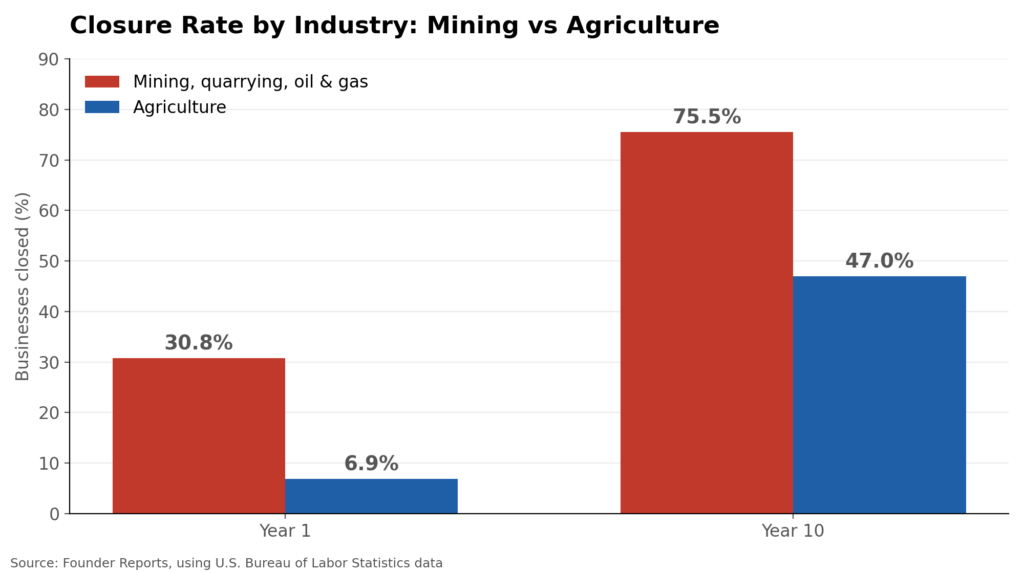
Roughly one in three survived a decade. Newer firms may be doing worse: Founder Reports says the March 2024 cohort lost 22.1% in year one. Industry matters too. Mining, quarrying and oil and gas extraction lost 30.8% in year one and 75.5% by year ten, while agriculture lost 6.9% and 47%.
Bankruptcies are climbing as well. According to Founder Reports, citing the U.S. courts, filings reached 25,960 in the 12 months to March 31, 2026, up 11.4% on a year earlier and the fourth annual rise in a row.
The Hidden Background: Failure Is the Default
Joseph Schumpeter coined “creative destruction” in his 1942 book Capitalism, Socialism and Democracy, according to a Richmond Fed review of a biography by Thomas McCraw. He meant capitalism’s constant replacement of old methods by new ones. That churn is healthy for an economy and brutal for the people inside it.
What changed lately is the cushion. Founder Reports says total U.S. bankruptcy filings hit a two-decade low of 380,634 in June 2022, then rose every quarter. It links this to high interest rates, refinancing pressure and the end of pandemic relief. Weak companies were being kept alive, and that support has gone.
Why the Mainstream Media Ignores Most of It
Here is my reading, and it is opinion rather than fact. Newsrooms cover events, and most failure is not an event. Founder Reports counts roughly 1.2 million establishments closing in 2024, with 3.6 million jobs lost, yet only about 24,000 business bankruptcies were filed that year. The rest never reach a courtroom, a press release or a headline.
Add the incentives. Business coverage leans toward funding rounds and billionaire profiles because readers and advertisers like them. A closed bakery has no famous founder to interview. And when failure is covered, it often shrinks to a recycled line that “half of businesses fail in five years,” with no mention that the figure describes one cohort, or that venture-backed startups fail for different reasons than shops and restaurants.
What the Pattern Really Says
Set the twelve companies against the statistics and a pattern appears. Almost none lacked money, talent or customers at the start. Leadership missed a shift or refused to act on it. Ansarada makes a similar point with Compaq, which lost focus after buying Tandem and DEC.
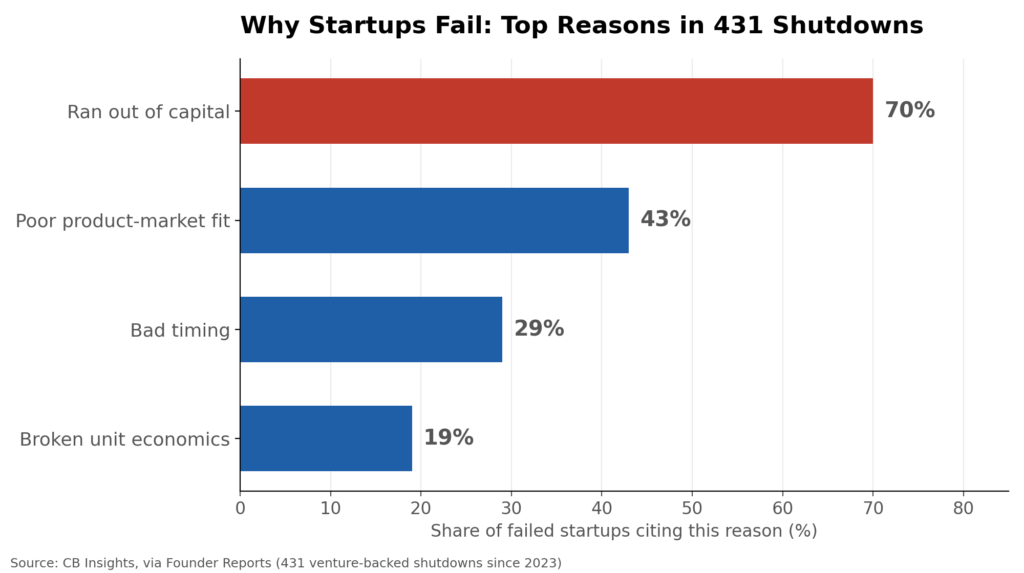
CB Insights, via Founder Reports, studied 431 venture-backed shutdowns since 2023. Running out of capital appeared in 70%, poor product-market fit in 43%, bad timing in 29% and broken unit economics in 19%. Empty bank accounts are the last symptom, not the root cause. Blockbuster did not die from a lack of cash. It died because it never moved when streaming reached its core customers.
Failure is not always final, though. Ansarada notes that Best Buy and Marvel both looked doomed and recovered.
Frequently Asked Questions About Business Failure
What is a business failure?
In the narrowest sense, it is a business that cannot pay its bills when they fall due, or that owes more than it owns. That is how Ansarada describes terminal insolvency. Founder Reports adds a useful distinction: a closure is any business that stops operating, a failure is a closure driven by financial distress, and a bankruptcy is a formal court filing.
Why do 90% of small businesses fail?
None of the sources used for this article support a 90% figure. Founder Reports, citing Bureau of Labor Statistics data, puts failures at 49.8% within five years and 65.3% within ten. For venture-backed startups, CB Insights found that running out of capital appeared in 70% of shutdowns and weak product-market fit in 43%.
What are the top 10 business failures in history?
There is no official ranking, and “biggest” depends on whether you count debt, jobs or reputation. By size, Zoviz notes that Lehman Brothers remains the largest bankruptcy filing in U.S. history. Ten well-known collapses covered above are Lehman Brothers, Enron, WeWork, Sears, Blockbuster, Kodak, Yahoo, Theranos, Toys “R” Us and MySpace.
What are the three types of business failure?
Zoviz sorts failed companies into three groups: those that missed a technology shift, those whose leadership committed fraud, and those whose growth or debt outran the business. In practice the groups overlap, and many collapses involve more than one cause.
What Could Happen Next
If borrowing stays expensive, filings may keep rising. Founder Reports says commercial Chapter 11 filings jumped about 37% year on year in early 2026, with distress concentrated in real estate, consumer goods, and energy and industrial firms. Those are the sectors to watch.
Lower interest rates could ease the pressure, though nothing in these sources promises it. What seems likely is that much of the damage will happen quietly, with small closures piling up while the public hears only about the famous ones.
