
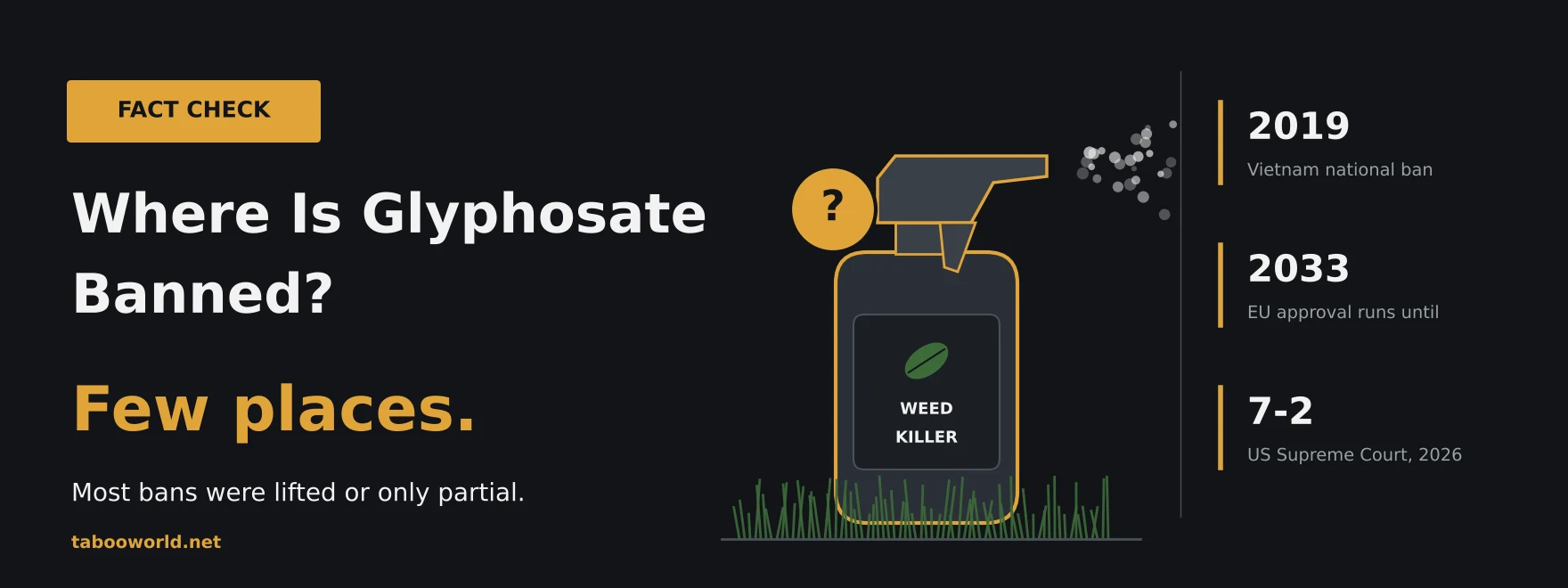
Listen to this article 1× Quick answer: Only Vietnam has a clear national glyphosate ban. Sri Lanka, Mexico and Thailand reversed theirs, most European rules only cover homes and parks, and the EU, US and UK all still allow it. Watch: Where glyphosate is really banned, in 56 seconds Why we checked this: most […]
Watch: Where glyphosate is really banned, in 56 seconds
Why we checked this: most “glyphosate ban” lists online date from 2019 and still count bans that were lifted or never enforced. We checked each country against government notices, court records and wire reports published up to November 2026.
Key facts at a glance
- Vietnam’s agriculture ministry removed glyphosate from its permitted list on April 10, 2019. Sales and use ended on June 30, 2021.
- The European Commission renewed glyphosate’s EU approval in November 2023, until December 15, 2033.
- Sri Lanka, the first country with a national ban (2015), lifted its import ban in August 2022.
- Mexico postponed its planned ban indefinitely in March 2024.
- The US Supreme Court ruled 7-2 for Monsanto in Monsanto v. Durnell on June 25, 2026.
- The EPA’s glyphosate registration review is now expected in early 2027.
Is glyphosate banned anywhere in the world?
Yes, but in far fewer places than most lists claim. Glyphosate is the active ingredient in Roundup and the most widely used weedkiller in the world. Governments that act against it usually choose one of four paths.
- National ban: import, sale and use are illegal across the country.
- Partial restriction: the herbicide stays legal on farms but is banned for home gardeners, in parks, or on certain crops.
- Lifted ban: a country banned it, then reversed the decision.
- Planned ban: a government announced a ban that never took effect.
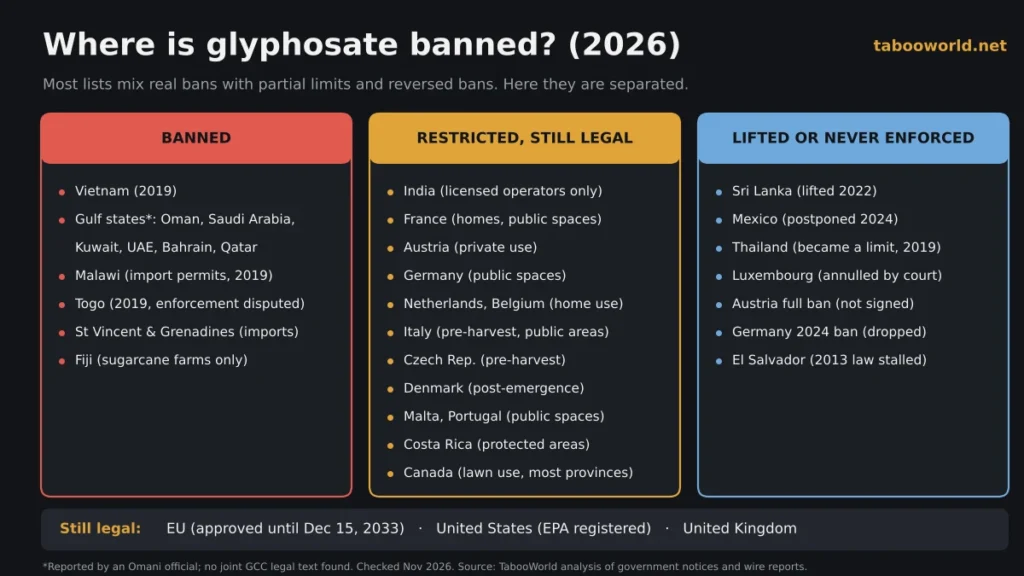
Popular lists mix all four together, which is how a “20 countries” figure from 2019 still circulates in 2026. The tables below separate them.
Which countries have banned glyphosate?
Only a short list of countries has moved against glyphosate nationwide, and the strength of the evidence varies.
| Country | Status | What the rule covers | Since |
|---|---|---|---|
| Vietnam | Banned | Removed from the permitted pesticide list by Decision 1186. Production and import stopped, and remaining stock could be sold until June 30, 2021. | 2019 |
| Oman, Saudi Arabia, Kuwait, UAE, Bahrain, Qatar | Reported ban | An Omani agriculture official said glyphosate had not been available since 2016 and was banned across the Gulf Cooperation Council. We found no joint GCC legal text. | 2015 to 2016 |
| Malawi | Import permits suspended | The agriculture ministry announced it would stop issuing import licences. | 2019 |
| Togo | Banned on paper | Import, marketing and use were prohibited, but enforcement has been disputed. | 2019 |
| St Vincent and the Grenadines | Import suspended | The government suspended imports on advice from its Pesticides Board. | 2018 |
| Fiji | Sector ban | Banned on sugarcane farms to meet Fairtrade rules. Other uses are not covered. | 2021 |
Vietnam is the clearest case. Its ministry published a formal decision, and US Agriculture Secretary Sonny Perdue publicly criticized the move in April 2019. The Gulf and African entries rest mostly on statements from officials and should be treated as weaker evidence.
Where is glyphosate restricted but still legal?
Most of the countries named in viral lists fall into this group. Farmers can still spray glyphosate, but home use, public spaces or certain crop uses are off limits.
| Country | What is restricted | Since |
|---|---|---|
| India | Only licensed pest control operators may apply it, under the Restriction on use of Glyphosate Order | 2022 |
| France | Public green spaces (2017) and home gardeners (2019) | 2017 |
| Austria | Private use and “sensitive” areas such as playgrounds | 2021 |
| Germany | Public spaces and water protection areas | In force |
| Netherlands | Sales to non-professional users | 2015 |
| Belgium | Sales of broad-spectrum herbicides to non-professional users | 2018 |
| Italy | Pre-harvest spraying and areas used by the public | 2016 |
| Czech Republic | Pre-harvest drying of crops | 2019 |
| Denmark | Use on crops after they emerge, to avoid food residues | 2018 |
| Malta and Portugal | Public spaces such as roadsides and school grounds | 2019 (Malta) |
| Costa Rica | The country’s protected wild areas | 2019 |
| Canada | Cosmetic lawn use in most provinces; federal approval stays in place | Varies by province |
India’s 2022 order is often reported as a “ban.” In practice, it moves application into the hands of licensed professionals rather than removing the product.
Which glyphosate bans were lifted or never took effect?
This is the group that most lists get wrong. Several famous bans no longer exist.
- Sri Lanka: President Maithripala Sirisena banned imports in 2015. Tea and rubber estates won an exemption in 2018. President Ranil Wickremesinghe lifted the import ban from August 5, 2022, and moved glyphosate to a list of goods that need a permit.
- Mexico: A 2020 presidential decree set a phase-out, later fixed for April 1, 2024. Days before that date, the government postponed it indefinitely, saying no viable substitute existed. In February 2025, after losing a USMCA trade panel, Mexico also repealed the decree’s restrictions on genetically modified corn.
- Thailand: A national committee voted to ban glyphosate from December 2019, then turned it into a use restriction before it took effect.
- Luxembourg: It withdrew glyphosate products in 2020 and banned remaining stocks from 2021. A Luxembourg court annulled the withdrawal in 2022, and the appeal court confirmed this in 2023.
- Austria: Parliament voted for a full ban in July 2019, but it was never signed into force. A narrower ban followed in 2021.
- Germany: A total ban planned for 2024 was dropped after the EU renewed glyphosate, since national law could not override EU approval.
- El Salvador: Lawmakers passed a ban in 2013 over links to kidney disease, but it stalled and glyphosate returned to use.
Colombia is a special case. It stopped aerial spraying of coca crops with glyphosate in 2015 over cancer concerns. In 2025, the government announced plans to resume limited manual and drone spraying.
Is glyphosate banned in Europe?
No. The European Commission renewed glyphosate’s approval for 10 years in November 2023, until December 15, 2033. EU member states could not reach a qualified majority for or against, so the Commission adopted its own proposal after reviews by the European Food Safety Authority (EFSA) and the European Chemicals Agency (ECHA).
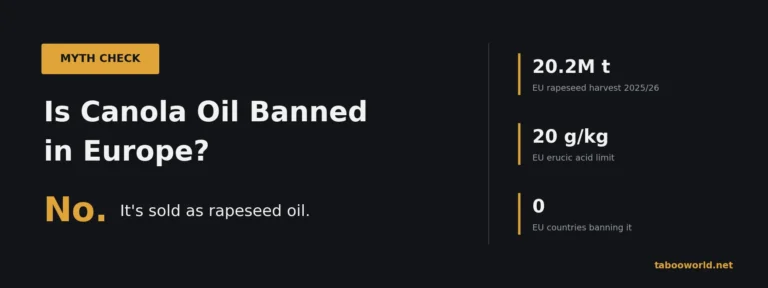
The renewal added new conditions, including buffer strips and drift-reducing equipment. Each member state still authorizes individual products, which is why France, Austria and others can keep their own partial restrictions. A full national ban, as Luxembourg discovered in court, is much harder to defend under EU law. Europe’s food rules confuse many shoppers, as we found when we checked the claim that canola oil is banned in Europe.
Is glyphosate banned in the United States?
No. Glyphosate is registered with the US Environmental Protection Agency (EPA) for farm and residential use. Its legal position actually strengthened in 2026.
On June 25, 2026, the Supreme Court ruled 7-2 in Monsanto Co. v. Durnell that federal pesticide law preempts state failure-to-warn claims. Justice Brett Kavanaugh wrote that a Missouri jury could not require a cancer warning that the EPA had not required. Justice Ketanji Brown Jackson, joined by Justice Neil Gorsuch, dissented. Legal analysts expect the ruling to end most remaining Roundup cancer lawsuits.
The science review is still open. The EPA withdrew its 2020 interim decision after a 2022 court loss, and in September 2026 it signed a research partnership with the Department of Health and Human Services. Officials now expect the final review in early 2027, and public comments on the literature search run until November 23, 2026.
Bans in the US exist only at the local level. Miami, New York City and Los Angeles County have stopped or restricted use on public property, and New York State banned it on state land from December 31, 2021. Bayer also replaced glyphosate in its US home-garden Roundup products by 2023, citing litigation risk rather than a regulatory order.
California added glyphosate to its Proposition 65 list of cancer-causing chemicals in July 2017. A federal court later blocked the warning requirement, and the Ninth Circuit upheld that block in 2023. Glyphosate is not the only chemical with a complicated US status. The FDA is phasing out Red Dye No. 3 in food by January 2027 after decades of debate.
Is glyphosate banned in the UK?
No. Glyphosate remains approved for use in Great Britain, and major retailers still sell it. Restrictions come from local councils instead. Westminster stopped using it in October 2022, and Edinburgh ended use in most council green spaces in April 2024.
Why do countries ban or restrict glyphosate?
The trigger for most action came in 2015. The World Health Organization’s cancer agency (IARC) classified glyphosate as “probably carcinogenic to humans.” Regulators including the EPA, EFSA and ECHA reached the opposite conclusion and found it unlikely to cause cancer at expected exposure levels.
US court cases added pressure. Vietnam halted imports in March 2019, days after a San Francisco federal jury found that Roundup was a substantial factor in a man’s cancer. In El Salvador, lawmakers also cited a possible link to chronic kidney disease among farm workers.
Trade and farm economics push the other way. Mexico and Sri Lanka both reversed course after farmers warned about crop losses. In Sri Lanka, the president’s office admitted that about a third of farmland was abandoned during one season of its wider agrochemical ban.
This article is general information, not medical or legal advice. Follow the product label and local rules.
Why do lists say glyphosate is banned in 20 or more countries?
Most of those lists trace back to a 2019 count by the campaign site Sustainable Pulse. It counted national bans, city rules, crop-specific limits and announced plans as one group. Several of those countries, including Sri Lanka, Thailand, Luxembourg and Mexico, later reversed or never enforced their bans.
Law-firm pages that track Roundup lawsuits use the same broad approach. Their lists are useful for local rules but rarely separate a lifted ban from an active one.
Key takeaways
- Vietnam has the clearest national glyphosate ban backed by a published government decision.
- Most European “bans” only cover home gardens, parks or pre-harvest spraying.
- Sri Lanka, Mexico, Thailand and Luxembourg no longer enforce the bans they once announced.
- The EU, US and UK all allow glyphosate, and the 2026 Supreme Court ruling protects US labels from state warning claims.
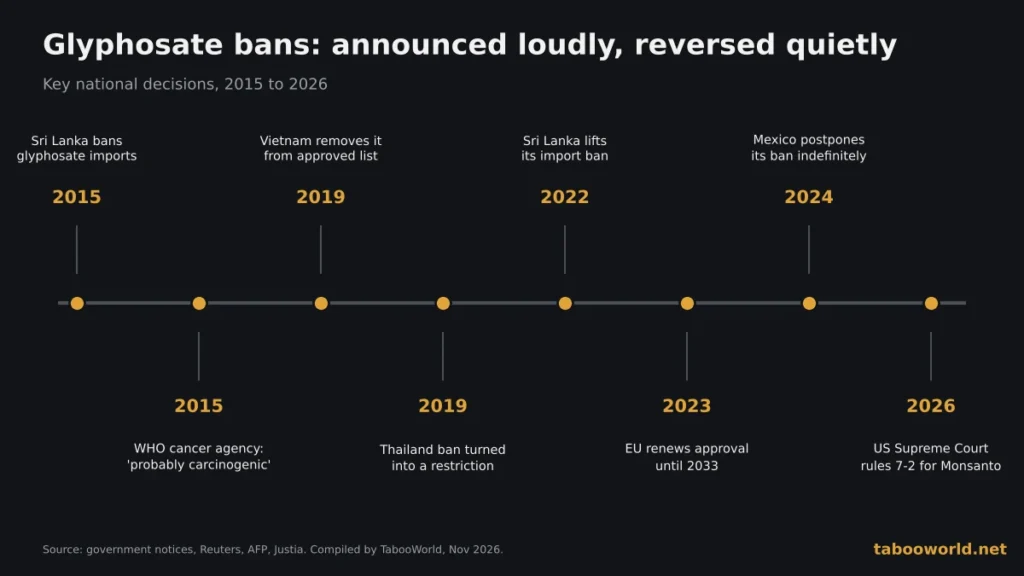
Glyphosate’s story shows how a ban can be announced loudly and reversed quietly. For more products that governments have pulled, restricted or reinstated, browse our database of bans by country.
FAQ
Which country banned glyphosate first?
Sri Lanka was the first country with a nationwide ban, introduced in 2015. It created an exemption for tea and rubber in 2018 and lifted the import ban in August 2022.
Is glyphosate banned in Germany?
No. Germany planned a full ban for 2024 but dropped it after the EU renewed glyphosate until 2033. It still bans use in public spaces and water protection areas.
Is glyphosate banned in Canada?
No. Health Canada still approves glyphosate. Most provinces restrict cosmetic pesticide use on lawns, and some cities go further on public land.
Did Mexico ban glyphosate?
Mexico planned to ban it from April 1, 2024, but postponed the ban indefinitely in March 2024. The government said it had not found a viable substitute.
Is Roundup still sold in the US?
Yes. Farm and commercial Roundup products still contain glyphosate. Bayer switched its US home-garden Roundup products to other ingredients by 2023.
Why is glyphosate controversial?
IARC classified it as probably carcinogenic in 2015, while the EPA, EFSA and ECHA found it unlikely to cause cancer. That split fuels lawsuits, local bans and repeated national debates.
Sources
- Vietnam Agriculture News: Glyphosate banned from June 30
- Vietstock: Decision 1186/QD-BNN-BVTV (April 2019)
- Reuters via Grainews: US criticizes Vietnam ban
- NFU: EU renews glyphosate approval for 10 years
- AFP via Phys.org: Commission renews glyphosate, new conditions
- Ada Derana: Sri Lanka lifts import ban (August 2022)
- EconomyNext: Glyphosate moved to permit list
- Reuters: Mexico delays glyphosate ban (March 2024)
- DTN: Mexico repeals GM corn restrictions (February 2025)
- Justia: Monsanto Co. v. Durnell (2026)
- Crowell: Supreme Court holds FIFRA preempts failure-to-warn claims
- Arkansas Advocate: EPA and HHS glyphosate review (September 2026)
- Mondaq: EPA comment deadline extended to November 23, 2026
- Agri-Pulse: EPA withdraws interim glyphosate decision
- Wisner Baum (law firm): glyphosate restriction tracker
- AFP via George Herald: Sri Lanka farmland abandoned during agrochemical ban
- Sustainable Pulse 2019 list (archived PDF)