





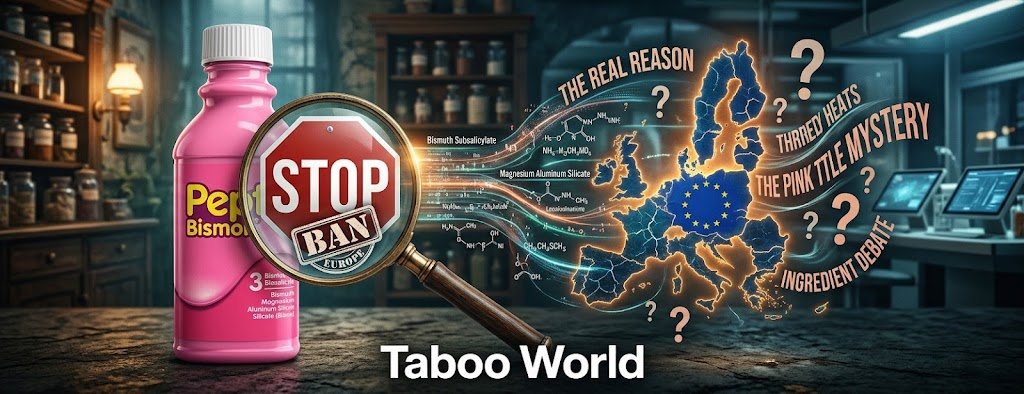
Quick answer: Pepto Bismol is not banned across all of Europe. The brand is simply hard to find in many European countries, and its active ingredient, bismuth subsalicylate, faces extra caution there. The two main worries are (1) a bismuth brain-toxicity scare that began in France in the 1970s, and (2) the aspirin-like salicylate in […]
Quick answer: Pepto Bismol is not banned across all of Europe. The brand is simply hard to find in many European countries, and its active ingredient, bismuth subsalicylate, faces extra caution there. The two main worries are (1) a bismuth brain-toxicity scare that began in France in the 1970s, and (2) the aspirin-like salicylate in the formula, which is linked to Reye’s syndrome in children. The UK is the big exception: Pepto-Bismol returned to UK shelves in 2025 for adults and teens aged 16 and over.
If you are an American traveler, an expat, or just curious, this guide explains what is true, what is myth, and what to buy instead. Pepto Bismol is far from the only everyday item that changes status at the border. Our Banned Around the World list tracks apps, foods, products and laws that are banned or restricted country by country.
Is Pepto Bismol Actually Banned in Europe?
Not exactly. This is the biggest gap in most articles on this topic. Many pages say “banned in Europe” as if one law covered the whole continent. That is not how it works.
Europe is a patchwork of countries with their own medicine rules, brands, and pharmacy habits. In some places the active ingredient is restricted or simply not marketed. In others it is sold. Travelers often discover this the hard way: they walk into a pharmacy and the familiar pink bottle is not on the shelf. It joins a long list of everyday products that are banned or restricted in some countries but sit on store shelves elsewhere.
A more accurate way to say it:
- Banned or heavily restricted: France is the best-known case, and you can see its current status in our Pepto Bismol entry on the France bans list. Some travel guides also list Denmark as restrictive.
- Hard to find: Many travelers report they cannot buy it over the counter in countries like Germany, Italy, and Switzerland. These are traveler reports, so check locally.
- Available: The UK, where the oral suspension is sold again.
Note for readers: rules change. Always ask a local pharmacist before you rely on any medicine abroad.
Why Is Pepto Bismol Banned in Europe? The Two Main Reasons
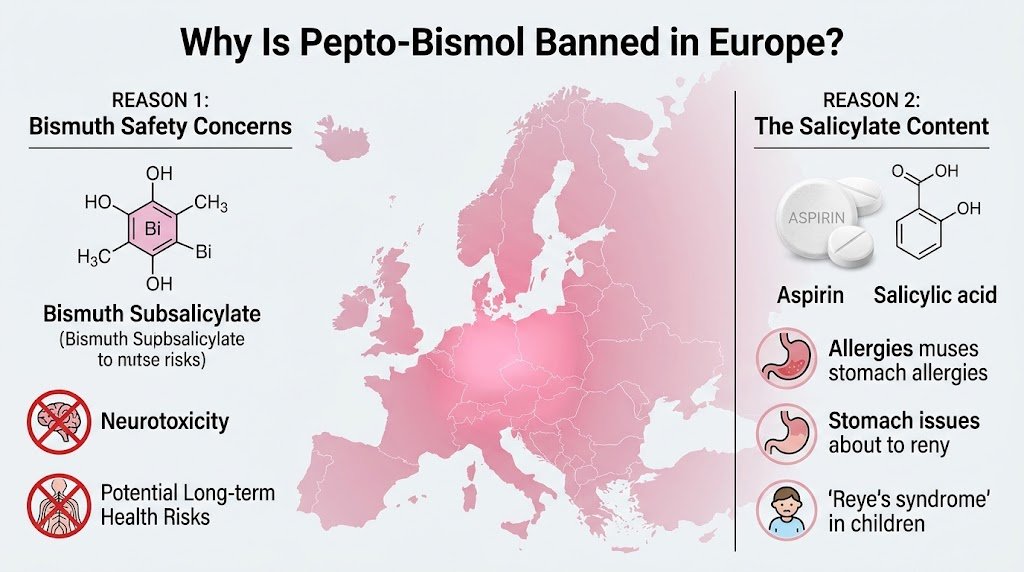
Two health concerns explain most of the caution.
Reason 1: Bismuth Safety Concerns
Pepto Bismol contains bismuth, a heavy metal. In very high doses or with long-term use, certain bismuth compounds have been linked to a rare brain condition called bismuth encephalopathy. Symptoms can include confusion, tremors, and muscle jerks (myoclonus), according to a published medical case report.
Reason 2: The Salicylate Content
Bismuth subsalicylate breaks down in the body, and the salicylate part is absorbed. Salicylates are in the same family as aspirin. The US label lists roughly 260 mg of salicylate in a 30 ml dose. That matters for:
- Children and teens recovering from flu or chickenpox (Reye’s syndrome risk)
- People allergic to aspirin
- People taking blood thinners or other salicylate medicines
Put together, these two issues make regulators and pharmacists in many European countries more cautious than US regulators.
Why Did France Ban Pepto Bismol?
France is the heart of the story. In the 1970s, France reported a cluster of cases of bismuth encephalopathy linked to oral bismuth products. The outbreak was serious enough to leave a lasting mark on French drug policy. France has a habit of firm rules here, as our list of things banned or restricted in France shows.
Here is what the research says:
- A scientific review in Drug Safety describes it as an epidemic of toxicity in France and surrounding countries, tied to inorganic bismuth salts such as subnitrate, subcarbonate, and subgallate.
- Patients generally recovered after stopping bismuth.
- The exact cause of the outbreak is still not fully understood, even decades later.
- French regulators (ANSM) still cite the 1970s experience today. When a modern bismuth-containing ulcer treatment called Pylera was approved in France, regulators asked for extra monitoring because of the earlier bismuth encephalopathy cases.
The key point most articles miss: The French outbreak was mostly linked to other bismuth salts, not bismuth subsalicylate. The case report cited above notes that bismuth subsalicylate appears less likely to cause neurotoxicity than those other bismuth compounds. But the caution stayed with the whole “bismuth” family.
Is Pepto Bismol Safe? Bismuth, Salicylate and Reye’s Syndrome
For most healthy adults using it short term as directed, bismuth subsalicylate is widely used and considered acceptable in the US, the UK, and many other countries. The risks tend to appear with misuse, long-term use, or in specific groups.
Is Pepto Bismol Bad for Your Stomach or Brain?
- Short-term use: Common side effects are a harmless black tongue and dark stools.
- Long-term overuse: A published case described a woman who developed bismuth encephalopathy after about 20 years of chronic, irregular use of bismuth subsalicylate tablets. Her symptoms improved after she stopped. This is rare, but it shows why labels say to stop if symptoms last more than two days.
Pepto Bismol and Reye’s Syndrome
Reye’s syndrome is a rare but serious illness, usually in children recovering from viral infections like flu or chickenpox. In 1982 the US Surgeon General advised against giving salicylates to children with these illnesses. That is why US labels carry a bold Reye’s warning and why the product is not meant for young children.
Why Don’t Doctors Always Recommend Pepto Bismol?
Doctors often prefer treatments that target one symptom, for example loperamide for diarrhea or an antacid for heartburn. Bismuth subsalicylate also interacts with some medicines. The CDC Yellow Book says travelers with aspirin allergy, gout, or kidney problems, and those taking anticoagulants, methotrexate, or probenecid, should not take it.
Pepto Bismol Availability by Country
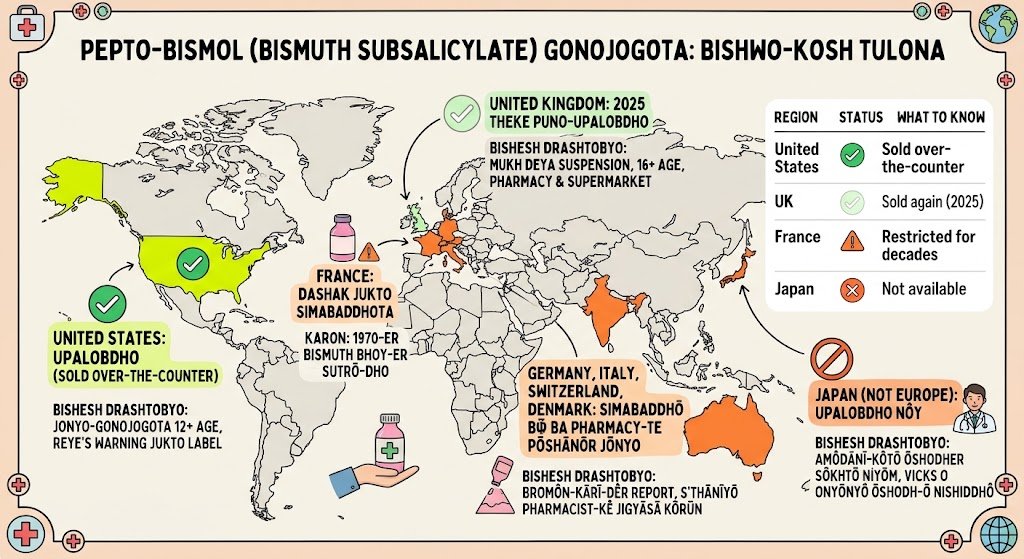
| Region | Status | What to know |
|---|---|---|
| United States | Sold over the counter | Labels allow ages 12+, with a Reye’s warning |
| United Kingdom | Sold again (2025) | Oral suspension, ages 16+, pharmacies and supermarkets |
| France | Restricted for decades | Rooted in the 1970s bismuth scare |
| Germany, Italy, Switzerland | Often not found over the counter | Based on traveler reports; ask a local pharmacist |
| Denmark | Reported as restricted | Reported by travel guides; verify locally |
| Japan (not Europe) | Not available | Japan is strict on imported medicines; it also bans Vicks inhalers and some cold medicines |
Is Pepto Bismol Available in the UK?
Yes. This is the part many “banned in Europe” articles get wrong. Procter & Gamble announced that Pepto-Bismol Oral Suspension is back in the UK, on supermarket shelves, online, and in pharmacies. It comes in 120 ml, 240 ml, and 480 ml bottles for adults and adolescents aged 16 and over. The UK dose is 30 ml every 30 to 60 minutes as needed, up to 8 doses in 24 hours.
Differences from the US version:
- Form: Liquid only in the UK launch (no tablets mentioned).
- Age limit: 16+ in the UK, versus 12+ on many US labels.
- Strength: 17.5 mg/ml bismuth subsalicylate.
Why Is Pepto Bismol Safe in the US but Not Sold in Europe?
It comes down to different regulators looking at the same evidence and drawing different conclusions.
- The US approach: The FDA treats bismuth subsalicylate as an over-the-counter ingredient with clear warning labels.
- The European approach: European countries regulate medicines nationally, and many are cautious about heavy-metal compounds and salicylates, especially after the French experience.
- Market reality: Even when something is legal, companies may not launch a product in a country if it is not worth the cost and paperwork.
So “banned” is often shorthand for “not approved, not marketed, or restricted in that country.” It works the other way too: the US has its own surprising rules, like the ban on Kinder Surprise eggs, a treat Europeans buy everywhere.
What Is the Best Pepto Bismol Alternative in Europe?
European pharmacies usually match the medicine to the symptom instead of selling one pink all-in-one remedy. Here are the common options, ranked by how well they replace Pepto Bismol for travelers:
- Loperamide (Imodium) for diarrhea. Rules on pack size and access vary by country, so ask the pharmacist.
- Alginate or antacid products (like Gaviscon) for heartburn and indigestion.
- Oral rehydration salts for fluid loss with diarrhea.
- Probiotics, which pharmacists in several countries tend to suggest.
- Ginger, bland foods, and plenty of water for mild upset stomach.
Pharmacist tip: Do not say “I need Pepto Bismol.” Describe your symptoms, for example “heartburn,” “nausea,” or “diarrhea,” and ask for the local equivalent.
Can You Bring Pepto Bismol to Europe?
Usually yes, for personal use. Travel guides note that EU countries may limit quantities, and for the Schengen zone a non-prescription medicine is commonly accepted up to about three months of personal supply. Still, rules vary.
If France is on your route, also read our update on whether it is safe to travel to France right now before you go.
Smart packing checklist:
- Keep it in the original packaging with the label visible.
- Bring only what you need for the trip.
- Check the rules of each country you will visit.
- Ask your doctor or pharmacist first if you take other medicines, especially blood thinners.
Who Should Avoid Pepto Bismol Anywhere in the World?
Skip it or talk to a doctor first if you:
- Are allergic to aspirin or salicylates
- Take blood thinners, or other salicylate medicines
- Have a stomach ulcer, bleeding problem, or black or bloody stool
- Are a child or teen with flu or chickenpox symptoms
- Are pregnant or breastfeeding
- Have kidney problems or gout
Stop use and seek medical advice if you notice ringing in the ears, hearing loss, or diarrhea that lasts more than 2 days.
Frequently Asked Questions
Why is Pepto Bismol banned in Europe?
It is not banned across all of Europe. It is restricted or unavailable in some countries because of a 1970s bismuth toxicity scare in France and concerns about its aspirin-like salicylate content.
Why did France ban Pepto Bismol?
France saw cases of bismuth encephalopathy in the 1970s linked to oral bismuth products, mostly other bismuth salts. That led to strict rules on bismuth medicines, which still shape French drug policy today.
Is Pepto Bismol banned in the UK?
No. Pepto-Bismol Oral Suspension is sold again in the UK for adults and adolescents aged 16 and over.
Is Pepto Bismol bad for your stomach?
Used short term as directed, it is generally well tolerated by healthy adults. Overuse or long-term use is the main concern. It can also darken your stool and tongue, which is harmless.
Why don’t doctors recommend Pepto Bismol?
Doctors often choose targeted medicines for a single symptom, and bismuth subsalicylate can interact with other drugs and is not suitable for everyone, including people on blood thinners or with aspirin allergy.
Is Benadryl banned in Europe?
There is no Europe-wide Benadryl ban, but brand names, strengths, and rules differ by country, and some medicines are restricted when traveling (for example, Benadryl is not permitted in Japan). People often search this alongside Pepto Bismol because both are popular US medicines that look different abroad. Check local rules and ask a pharmacist.
What is the Pepto Bismol alternative in Europe?
There is no single replacement. Use loperamide for diarrhea, Gaviscon-type products for heartburn, and oral rehydration salts for fluid loss. Ask a local pharmacist.
Why do Americans drink Pepto Bismol?
It is a trusted over-the-counter remedy in the US, sold for five symptoms: nausea, heartburn, indigestion, upset stomach, and diarrhea. Many people keep a bottle at home.
Can bismuth subsalicylate cause brain problems?
Rarely. Cases of bismuth encephalopathy have been reported mainly with long-term, heavy use, and symptoms usually improve after stopping.
Can I take Pepto Bismol while traveling to prevent diarrhea?
Bismuth subsalicylate is the main non-antibiotic option studied for preventing travelers’ diarrhea, but the CDC says some groups should not use it. Talk to your doctor before your trip.
Final Verdict: Banned, Restricted, or Just Misunderstood?
So, why is Pepto Bismol banned in Europe? The honest answer is that it is not banned everywhere. It is a case of cautious regulation, history, and market choices. France’s 1970s bismuth scare and worries about salicylates created a lasting reputation, while the UK has now brought it back for older teens and adults.
If you are traveling, check local rules, pack what you need in its original box, and learn the local symptom-based alternatives. If you have any health condition or take regular medicines, talk to a doctor or pharmacist first. To stay ahead of unsafe products at home, see our guide to the best apps for tracking product recalls and safety alerts.
This article is for general information only and is not medical advice. Always read the label and consult a qualified healthcare professional.