

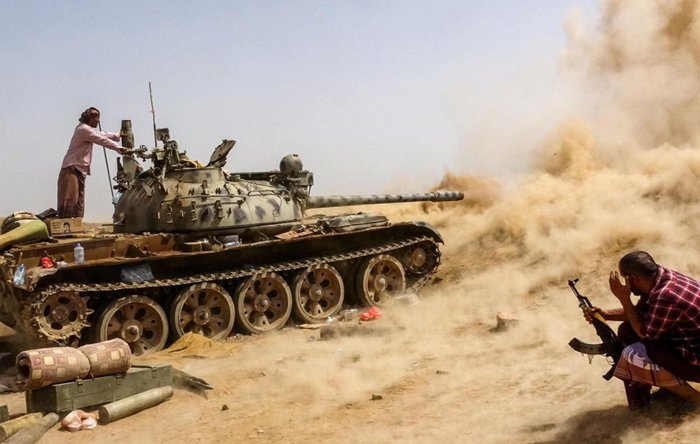
Saudi-led coalition forces say they intercepted a ballistic missile fired by the Houthis toward the Saudi city of Khamis Mushait. The attempted strike comes as fighting across Yemen grows fiercer, with air raids, airport attacks and a major ground push all unfolding at once. Coalition spokesman Major-General Turki al-Malki confirmed that air defences destroyed the […]
Saudi-led coalition forces say they intercepted a ballistic missile fired by the Houthis toward the Saudi city of Khamis Mushait. The attempted strike comes as fighting across Yemen grows fiercer, with air raids, airport attacks and a major ground push all unfolding at once.
Coalition spokesman Major-General Turki al-Malki confirmed that air defences destroyed the missile before it could reach its target. The announcement came amid a rapid escalation along the Saudi-Yemeni frontier and as regional tensions linked to the wider Iran war continue to rise.
Missile Aimed at Khamis Mushait Intercepted
Al-Malki said the coalition’s forces brought down the ballistic missile after the Houthis launched it at Khamis Mushait. The city lies in southwestern Saudi Arabia, not far from the Yemeni border, which puts it within reach of Houthi weapons.
No damage or casualties from the interception were mentioned in the information available so far. Even so, the launch shows the Houthis are still willing to fire at Saudi urban areas, and that the coalition is working to stop those attacks as the conflict heats up.
Airports Near the Border Come Under Attack
The Houthi missile was not the only incident. Two airports in southern Saudi Arabia, in Jizan and Najran, were also targeted. Saudi officials said the attacks left people injured and caused damage. Reports point to three people wounded.
Both cities sit close to the Yemeni border, so they have often been exposed to cross-border fire during the long conflict. Hitting airports can disrupt civilian travel and local logistics, and it sends a political message as well.
In response, the Saudi-led coalition has carried out a series of air strikes on Houthi weapon sites inside Yemen. The raids appear aimed at the launch and storage facilities used to fire missiles and drones across the border. The coalition has not made public the full scale of the strikes.
Yemeni Government Forces Claim Gains Near Bab al-Mandeb
The fighting is not limited to the air. On the ground, the military of Yemen’s internationally recognised government says it has retaken the strategic port city of Mocha. It also says it has begun a large counteroffensive to push the Houthis out of important positions near the Bab al-Mandeb strait.
Bab al-Mandeb is a narrow waterway linking the Red Sea to the Gulf of Aden, and it is one of the world’s key shipping routes. Whoever controls the surrounding coast has real influence over maritime traffic, which is why the area matters far beyond Yemen’s own borders.
Reports also say government-aligned forces claim to have taken sites near Dhubab, close to the strait. These claims come from the government side, and the Houthis have not been heard in the information gathered here. Battlefield assertions in Yemen often take time to verify, so the true picture on the ground may change.
Iran Warns Its Military Is Ready
Behind the fighting in Yemen lies the wider confrontation involving Iran. A senior Iranian security official has warned that the country’s military is “more prepared than ever,” with its “fingers on the trigger,” and is waiting for any miscalculation by the United States or Israel, a country Iranian officials refer to as “the Zionist regime.”
The warning follows Tehran’s recent message to Washington that there is no military solution to end the war. Taken together, the statements show Iran presenting itself as both ready for escalation and open to a political settlement, while placing responsibility for any widening of the conflict on its rivals.
The Houthis have long been seen as part of the network of groups aligned with Tehran, which is why developments in Yemen are closely watched in the context of the larger regional war. Whether the latest clashes will draw in more actors remains unclear.
What the Latest Developments Suggest
Several points stand out from the day’s events:
- Pressure on Saudi territory is growing. A missile aimed at Khamis Mushait and attacks on two airports show the Houthis are reaching deep into southern Saudi Arabia.
- The coalition is hitting back hard. Air strikes on weapon sites indicate an effort to cut off the source of the attacks rather than only defend against them.
- The ground war is moving. The reported recapture of Mocha and the counteroffensive near Bab al-Mandeb could shift control of a vital stretch of coastline.
- The regional backdrop is tense. Iran’s public warning leaves little room for calm, even as it says it wants no wider war.
Civilians and Shipping at Risk
For people living in southern Saudi Arabia and across Yemen, the escalation brings fresh danger. Attacks on airports and cities put civilians at risk, while heavy fighting around ports and coastal areas can disrupt supplies in a country already struggling with severe hardship.
Global shipping could also feel the effects if the battle for the Bab al-Mandeb area continues. Any threat to that route tends to ripple through trade and energy markets, so international observers are watching closely.
What Comes Next
With the coalition striking Houthi sites, government forces pushing along the coast and Iran issuing sharp warnings, the situation is changing quickly. Further missile launches, more air strikes and additional claims from the battlefield are all likely in the coming days.
Independent confirmation of the territorial claims and the full toll of the airport attacks will be key to understanding how serious this latest phase is. For now, the interception of the missile aimed at Khamis Mushait is one more sign that the fighting is spreading and that diplomacy has yet to catch up with events on the ground.
FAQ
Did the Houthis fire a missile at Khamis Mushait and was it intercepted?
Yes, the Houthis launched a ballistic missile toward Khamis Mushait, and coalition air defenses destroyed it before it could reach the city.
Were there any casualties from the missile interception over Khamis Mushait?
No, the article reports no damage or casualties were mentioned after the missile was intercepted.
Which Saudi airports were hit in the recent Houthi attacks and how many people were injured?
Airports in the southern Saudi cities of Jizan and Najran were targeted, and the attacks wounded three people.
How did the Saudi-led coalition respond to the Houthi missile launch?
The coalition responded by carrying out air strikes on Houthi weapon sites inside Yemen.




5 Comments